Thursday, May 15, 2025

27.6 我 ê 寶藏已經 hông 搶去

27.6 Góa ê pó-chōng í-keng hông chhiúⁿ-khì

"... Góa kín chhìn-chhái kā yi ìn, khióng-kiaⁿ bô sî-kan hôe-tap, ‘Tān-goān lí kóng ê chò ē-kàu, hu-jîn. Lí ū té-to kò͘ lí ê êng-ū, góa ū kiàm thang pó-hō͘ lí, a̍h tī sî-ki tùi lán put-lī ê sî chū-sat.’

"Góa siūⁿ yi bô thiaⁿ oân góa ê ōe, in-ūi góa kám-kak ū-lâng kóaⁿ kín-kín kā yi kiò cháu, in-ūi sin-lông teh tán ah. Taⁿ, góa pi-siong ê àm-iā kàu-ūi ah, góa khoài-lo̍k ê ji̍t-thâu mā lo̍h-soaⁿ ah. Góa ê ba̍k-chiu ian-n̄g, sim-su hūn-loān. Góa bē-tàng ji̍p yin chhù, mā bô hoat-tō͘ chhòng-siáⁿ. Tān, siūⁿ-tio̍h bān-it hoat-seng siáⁿ tāi-chì, góa ê chāi-tiûⁿ kài iàu-kín. Góa thê-khí ióng-khì ji̍p-khì, in-ūi góa tùi yin chhù ê chhut-ji̍p kháu chin se̍k. Lēng-gōa, in-ūi chhù-lāi su-té-hā loān chhau-chhau, bô lâng chù-ì tio̍h góa, só͘-tì bô-lâng hoat-hiān góa. Góa chhōe tio̍h chi̍t-ê hó ki-hōe, kā ka-tī siám kàu tōa-thiaⁿ chi̍t-ê thang-á lap-o ê só͘-chāi, bih tī nn̄g-phìⁿ thang-á-lî āu-bīn. Ùi he phāng góa khòaⁿ ē-tio̍h pâng-keng lāi hoat-seng ê it-chhè, tān bô lâng ē khòaⁿ-tio̍h góa. Siáng ē-tàng biô-siá góa khiā tī hia sim-chêng ê kek-tōng: sim-koaⁿ só͘ siūⁿ, í-ki̍p siám kòe náu-hái ê chióng-chióng ì-liām? Che bô hoat-tō͘ kóng, siōng hó mā mài kóng.

"Án-ne kóng tō ū-kàu ah: sin-lông chhēng ji̍t-siông ho̍k-chong ji̍p kàu tōa-thiaⁿ, bô án-chóaⁿ chng-pān. Kap sin-lông tâng-chê ê sī Luscinda ê chi̍t-ê piáu-tē, koh tî-liáu chhù lāi po̍k-jîn í-gōa, pâng-keng bô kî-thaⁿ ê lâng. Kòe chi̍t-ē-á, Luscinda ùi chêng-pâng chhut-lâi, iû yin lāu-bú kap 2-ê lú-po̍k pôe-phōaⁿ. Yi ê chhēng-chhah kap táⁿ-pān oân-choân hû-ha̍p sin-hūn kap bí-māu, ho̍k-chong hôa-lē koh hí-khì. Góa ê sim cho koh hoân, bô hoat-tō͘ koan-chhat a̍h te̍k-pia̍t chù-ì yi chhēng siáⁿ. Góa kan-ta chù-ì tio̍h he sek-tì sī chhim-âng kap pe̍h. Yi thâu-khak téng kap saⁿ-á téng ê pó-chio̍h kap chu-pó kim sih-sih, tān koh-khah chhut-sek ê sī yi he o͘ sìm-sìm ê thâu-mo͘, kong-bông iâⁿ-kòe pó-chio̍h í-ki̍p tiám tī tōa-thiaⁿ hit 4-pha chiò kah iāⁿ-iāⁿ sih ê teng-hóe. 

"Oh, kì-tî, hō͘ góa bē-tit an-lêng! Sī án-chóaⁿ taⁿ boeh kā hit-ê bí-māu bô tè pí ê góa só͘ chông-pài ê te̍k-jîn chhōa kàu góa bīn-chêng? Chân-jím ê kì-tî ah, lí put-jû thê-chhéⁿ góa siūⁿ-khí hit-sî yi ê só͘ chò, he bêng-hián ê put-gī hō͘ góa siū-khì, mài kóng taⁿ khì kā pò-ho̍k, siōng-bô ē-sái kiat-sok góa ka-tī ê sèⁿ-miā, án-ne kám m̄-sī khah hó? Sian-siⁿ, chhiáⁿ m̄-thang ià-siān góa kóng che lī-tê ê ōe. Góa ê pi-siong m̄-sī kán-té kúi-kù tō kóng ē-bêng; góa jīn-ûi múi chi̍t-ê sū-kiāⁿ lóng su-iàu chē-chē ê ōe-gí."

Tùi che, sîn-hū ìn kóng, in thiaⁿ liáu bē ià-siān, jî-chhiáⁿ tùi i kóng tio̍h ê sè-chiat kài ū hèng-chhù, he bē-sái kiám-séng, ta̍t-tit kap chú-iàu kò͘-sū kāng-khoán ê tiōng-sī.

"Sòa lo̍h-lâi," Cardenio kè-sio̍k kóng, "ta̍k-ê chi̍p tī toa-thiaⁿ, kàu-khu sîn-hū ji̍p-lâi, jiân-āu chiàu gî-sek khan-khí chit-tùi sin-lâng ê chhiú, mn̄g kóng: ‘Luscinda Sc [Sió-chiá], lí goān-ì chiàu Sèng-bó Kàu-tn̂g ê kui-tēng, kè hō͘ chit-ê Don Fernando Ss [Sian-siⁿ] chò lí ê ha̍p-hoat ang-sài bô?’ Hit-sî, góa kā thâu chhun-chhut thang-á-lî ê phāng, àⁿ hīⁿ-khang koh sim-koaⁿ phi̍h-pho̍k chhái, boeh thiaⁿ Luscinda ê hôe-tap, tán-thāi yi ê hôe-tap tàu-té sī phòaⁿ sí a̍h phòaⁿ oa̍h. Oh, tān-goān hit-sî góa káⁿ chông chhut-lâi, tōa-siaⁿ hoah:

"‘Luscinda, Luscinda! Chù-ì lí ê só͘ chò. Siūⁿ khòaⁿ lí tah-èng góa ê tāi-chì. Tio̍h chai, lí sī góa ê, bē-sái sī pa̍t-lâng ê. Thiaⁿ hō͘ hó, lí kóng "Góa goān-ì" ê tông-sî mā sī góa sèⁿ-miā kiat-sok ê sî. O, lí chit-ê pōe-sìn put-gī ê Don Fernando! Lí toa̍t-cháu góa ê êng-iāu, hāi-sí góa ê sèⁿ-miā! Lí sī teh chhòng-siáⁿ? Kì hō͘ hó, chò chi̍t-ê Kitok-tô͘, lí bē-tàng án-ne tit-tio̍h lí hi-bāng ê mi̍h-kiāⁿ. Luscinda sī góa ê sin-niû, góa chiah sī yi ê ang-sài!’

 "Góa sī chi̍t-ê gōng-tai! Taⁿ góa í-keng lī-khui hn̄g-hn̄g, bô hûi-hiám ah. Hit-sî, góa si̍t-chāi tio̍h chiàu góa só͘ kóng ê chò, m̄-koh góa bô. Taⁿ, góa pó-kùi ê pó-chōng í-keng hông chhiúⁿ khì, góa chiù-chhàm chhiúⁿ-tô͘. Góa nā ū-sim boeh ho̍k-siû, tō ná góa ai-thàn góa ê ūn-miā kāng-khoán, góa goân-pún ē-tàng án-ne chò. Kán-tan kóng, hit-sî góa sī bô-táⁿ koh gōng-tai, chiah ē chit-chūn kiàn-siàu, àu-náu, koh siáu kah boeh sí...

--

27.6 我 ê 寶藏已經 hông 搶去

"... 我緊凊彩 kā 她應, 恐驚無時間回答, ‘但願你講 ê 做 ē 到, 夫人. 你有短刀顧你 ê 榮譽, 我有劍 thang 保護你, a̍h tī 時機 tùi 咱不利 ê 時自殺.’

"我想她無聽完我 ê 話, 因為我感覺有人趕緊緊 kā 她叫走, 因為新郎 teh 等 ah. 今, 我悲傷 ê 暗夜到位 ah, 我快樂 ê 日頭 mā 落山 ah. 我 ê 目睭 ian-n̄g, 心思混亂. 我 bē-tàng 入姻厝, mā 無法度創啥. 但, 想著萬一發生啥代誌, 我 ê 在場 kài 要緊. 我提起勇氣入去, 因為我 tùi 姻厝 ê 出入口真熟. 另外, 因為厝內私底下亂操操, 無人注意著我, 所致無人發現我. 我揣著一个好機會, kā ka-tī 閃到大廳一个窗仔 lap-o ê 所在, 覕 tī 兩片窗仔簾後面. Ùi he 縫我看會著房間內發生 ê 一切, 但無人 ē 看著我. Siáng ē-tàng 描寫我徛 tī hia 心情 ê 激動: 心肝所想, 以及閃過腦海 ê 種種意念? Che 無法度講, 上好 mā 莫講.

"Án-ne 講 tō 有夠 ah: 新郎穿日常服裝入到大廳, 無按怎裝扮. Kap 新郎同齊 ê 是 Luscinda ê 一个表弟, koh 除了厝內僕人以外, 房間無其他 ê 人. 過一下仔, Luscinda ùi 前房出來, 由姻老母 kap 2 个女僕陪伴. 她 ê 穿插 kap 打扮完全符合身份 kap 美貌, 服裝華麗 koh 喜氣. 我 ê 心慒 koh 煩, 無法度觀察 a̍h 特別注意她穿啥. 我 kan-ta 注意著 he 色致是深紅 kap 白. 她頭殼頂 kap 衫仔頂 ê 寶石 kap 珠寶金 sih-sih, 但 koh-khah 出色 ê 是她 he 烏 sìm-sìm ê 頭毛, 光芒贏過寶石以及點 tī 大廳 hit 4 葩照 kah iāⁿ-iāⁿ sih ê 燈火. 

"Oh, 記持, hō͘ 我袂得安寧! 是按怎今欲 kā 彼个美貌無塊比 ê 我所崇拜 ê 敵人𤆬到我面前? 殘忍 ê 記持 ah, 你不如提醒我想起彼時她 ê 所做, he 明顯 ê 不義 hō͘ 我受氣, 莫講今去 kā 報復, 上無 ē-sái 結束我 ka-tī ê 性命, án-ne kám 毋是 khah 好? 先生, 請 m̄-thang 厭僐我講 che 離題 ê 話. 我 ê 悲傷毋是簡短幾句 tō 講 ē 明; 我認為每一个事件 lóng 需要濟濟 ê 話語."

Tùi che, 神父應講, in 聽了袂厭僐, 而且 tùi 伊講著 ê 細節 kài 有興趣, he bē-sái 減省, 值得 kap 主要故事仝款 ê 重視.

"紲落來," Cardenio 繼續講, "逐个集 tī 大廳, 教區神父入來, 然後照儀式牽起 chit 對新人 ê 手, 問講: ‘Luscinda Sc [小姐], 你願意照聖母教堂 ê 規定, 嫁 hō͘ 這个 Don Fernando Ss [先生] 做你 ê 合法翁婿無?’ 彼時, 我 kā 頭伸出窗仔簾 ê 縫, àⁿ 耳空 koh 心肝 phi̍h-pho̍k 採, 欲聽 Luscinda ê 回答, 等待她 ê 回答到底是判死 a̍h 判活. Oh, 但願彼時我 káⁿ 傱出來, 大聲喝:

"‘Luscinda, Luscinda! 注意你 ê 所做. 想看你答應我 ê 代誌. Tio̍h 知, 你是我 ê, bē-sái 是別人 ê. 聽 hō͘ 好, 你講 "我願意" ê 同時 mā 是我性命結束 ê 時. O, 你這个背信不義 ê Don Fernando! 你奪走我 ê 榮耀, 害死我 ê 性命! 你是 teh 創啥? 記 hō͘ 好, 做一个 Kitok 徒, 你 bē-tàng án-ne 得著你希望 ê 物件. Luscinda 是我 ê 新娘, 我才是她 ê 翁婿!’

 "我是一个戇呆! 今我已經離開遠遠, 無危險 ah. 彼時, 我實在 tio̍h 照我所講 ê 做, m̄-koh 我無. 今, 我寶貴 ê 寶藏已經 hông 搶去, 我咒懺搶徒. 我若有心欲復仇, tō ná 我哀嘆我 ê 運命仝款, 我原本 ē-tàng án-ne 做. 簡單講, 彼時我是無膽 koh 戇呆, 才 ē 這陣見笑, 懊惱, koh 痟 kah 欲死...

--

27.6

I replied to her distractedly and hastily, in fear lest I should not have time to reply, ‘May thy words be verified by thy deeds, lady; and if thou hast a dagger to save thy honour, I have a sword to defend thee or kill myself if fortune be against us.’

“I think she could not have heard all these words, for I perceived that they called her away in haste, as the bridegroom was waiting. Now the night of my sorrow set in, the sun of my happiness went down, I felt my eyes bereft of sight, my mind of reason. I could not enter the house, nor was I capable of any movement; but reflecting how important it was that I should be present at what might take place on the occasion, I nerved myself as best I could and went in, for I well knew all the entrances and outlets; and besides, with the confusion that in secret pervaded the house no one took notice of me, so, without being seen, I found an opportunity of placing myself in the recess formed by a window of the hall itself, and concealed by the ends and borders of two tapestries, from between which I could, without being seen, see all that took place in the room. Who could describe the agitation of heart I suffered as I stood there—the thoughts that came to me—the reflections that passed through my mind? They were such as cannot be, nor were it well they should be, told. /

Suffice it to say that the bridegroom entered the hall in his usual dress, without ornament of any kind; as groomsman he had with him a cousin of Luscinda’s and except the servants of the house there was no one else in the chamber. Soon afterwards Luscinda came out from an antechamber, attended by her mother and two of her damsels, arrayed and adorned as became her rank and beauty, and in full festival and ceremonial attire. My anxiety and distraction did not allow me to observe or notice particularly what she wore; I could only perceive the colours, which were crimson and white, and the glitter of the gems and jewels on her head dress and apparel, surpassed by the rare beauty of her lovely auburn hair that vying with the precious stones and the light of the four torches that stood in the hall shone with a brighter gleam than all. /

Oh memory, mortal foe of my peace! why bring before me now the incomparable beauty of that adored enemy of mine? Were it not better, cruel memory, to remind me and recall what she then did, that stirred by a wrong so glaring I may seek, if not vengeance now, at least to rid myself of life? Be not weary, sirs, of listening to these digressions; my sorrow is not one of those that can or should be told tersely and briefly, for to me each incident seems to call for many words.”

To this the curate replied that not only were they not weary of listening to him, but that the details he mentioned interested them greatly, being of a kind by no means to be omitted and deserving of the same attention as the main story.

“To proceed, then,” continued Cardenio: “all being assembled in the hall, the priest of the parish came in and as he took the pair by the hand to perform the requisite ceremony, at the words, ‘Will you, Señora Luscinda, take Señor Don Fernando, here present, for your lawful husband, as the holy Mother Church ordains?’ I thrust my head and neck out from between the tapestries, and with eager ears and throbbing heart set myself to listen to Luscinda’s answer, awaiting in her reply the sentence of death or the grant of life. Oh, that I had but dared at that moment to rush forward crying aloud, /

‘Luscinda, Luscinda! have a care what thou dost; remember what thou owest me; bethink thee thou art mine and canst not be another’s; reflect that thy utterance of “Yes” and the end of my life will come at the same instant. O, treacherous Don Fernando! robber of my glory, death of my life! What seekest thou? Remember that thou canst not as a Christian attain the object of thy wishes, for   is my bride, and I am her husband!’ /

Fool that I am! now that I am far away, and out of danger, I say I should have done what I did not do: now that I have allowed my precious treasure to be robbed from me, I curse the robber, on whom I might have taken vengeance had I as much heart for it as I have for bewailing my fate; in short, as I was then a coward and a fool, little wonder is it if I am now dying shame-stricken, remorseful, and mad.

--


27.5 Koh 兩工 tō 欲私下過定

27.5 Koh nn̄g-kang tō boeh su-hā kòe-tiāⁿ

"... Chit-ê kau-tài góa kài siūⁿ boeh ûi-pōe, in-ūi chāi góa khòaⁿ, góa bô khó-lêng jím-siū kap Luscinda hun-khui chiah chē kang, iû-kî sī, chhiūⁿ góa só͘ biô-siá ê, tī hit-chióng siong-sim ê sim-chêng lī-khui yi. Put-jî-kò, chò chi̍t-ê chīn-chit ê sin-lô, góa ū kā chun-siú, sui-bóng góa jīn-ûi che hāi-tio̍h góa ê lī-ek. M̄-koh, kòe 4-kang liáu-āu, ū chi̍t-ê lâng chah chi̍t-tiuⁿ phe lâi chhōe góa, khòaⁿ he chū-chí góa chai sī Luscinda só͘ kià ê, pit-chek mā sī yi ê.

Góa sim kiaⁿ-kiaⁿ thiah-khui phe, siong-sìn tek-khak ū siáⁿ giâm-tiōng ê tāi-chì, yi chiah ē siá phe hō͘ chhut-gōa ê góa, in-ūi goán chiū-kīn ê sî, yi hán-tit siá-phe. Tha̍k phe chìn-chêng, góa mn̄g hit-ê lâng, sī siáng kau hō͘ i, i iân-lō͘ lâi kiâⁿ gōa kú. I kā góa kóng, tiong-tàu kiâⁿ tī chhī-lāi chi̍t-tiâu ke-lō͘ ê sî, chi̍t-ê chiok súi ê hu-jîn ùi thang-á kiò i, ba̍k-sái kâm ba̍k-kîⁿ, kóaⁿ kín-kín án-ne kā i kóng:

"‘Hiaⁿ-tī, khòaⁿ-lâi lí sī Kitok-tô͘, khòaⁿ tī Sîn ê bīn, góa kiû lí chek-khek kā chit-tiuⁿ phe kau hō͘ tē-chí só͘ siá ê só͘-chāi kap lâng, he chin hó chhōe, lí án-ne chò sī tùi Chú ê tōa ho̍k-bū. Lí chò che bē kài mâ-hoân, chhiú-kin lāi-bīn ê mi̍h-kiāⁿ sī boeh hō͘ lí.’

"Sòa-loeh i koh kóng:

"‘Chū án-ne, yi hiat hō͘ góa chi̍t-tiâu chhiú-kin-á, lāi-bīn pau 100 real ê chîⁿ kap chit-kha kim chhiú-chí. Che góa kap hit-tiuⁿ kià hō͘ lí ê phe tâng-chê chah lâi. Bô tán góa hôe-ōe, yi tō lī-khui thang-á. M̄-koh, yi ū khòaⁿ tio̍h góa khioh phe kap chhiú-kin-á, í-ki̍p góa kō͘ chhiú-sè piáu-sī kóng, góa ē chiàu yi só͘ kóng ê khì chò. Hoat-hiān ūi lí sàng phe ê pò-siû hiah hó, koh ùi tē-chí chai che phe sī kià hō͘ lí (in-ūi, sian-siⁿ, góa tùi lí chin liáu-kái), lēng-gōa góa mā put-jím khòaⁿ hu-jîn lâu ba̍k-sái, góa koat-tēng boeh ka-tī chhin-sin sàng hō͘ lí, bô boeh khò pa̍t-lâng. Chū he phe kau góa kàu taⁿ, góa chi̍t-lō͘ khai 16 tiám-cheng. Lí chai lah, hia lī chia 18 league [86.4 km].'

"Chit-ūi lîm-sî the̍h-phe-á kā góa kóng che ê sî, góa thiaⁿ kah sîn-sîn, siang-kha khu̍h-khu̍h chùn, kiông boeh khiā bē chāi. Chóng--sī, góa phah-khui phe, tha̍k-tioh chiah-ê ōe:

=

Don Fernando tah-èng boeh chhiáⁿ lín lāu-pē lâi kā goán lāu-pē thê-chhin, i kā si̍t-hiān tī ka-tī ê boán-ì, bô kò͘ lí ê hok-lī. Góa tio̍h kā lí kóng, sian-siⁿ, i boeh chhōa góa chò khan-chhiú. Goán lāu-pē jīn-ûi Don Fernando ê tiâu-kiāⁿ khah hó kòe lí, í-keng tah-èng i. Koh nn̄g-kang tō boeh su-hā kòe-tiāⁿ, kiàn-chèng ê lâng kan-ta sī Thiⁿ-kong kap kúi-ê chhin-chiâⁿ. Góa chit-chūn ê chōng-hóng, lí siūⁿ tō chai. Ē-tit lâi, tio̍h kín lâi. Tāi-chì ê kiat-kio̍k ē hō͘ lí chai, góa sī m̄-sī ài lí. Goān Sîn hō͘ che phe, tī góa ê chhiú hō͘ hit-ê sit-sìn ê lâng khan-khì í-chêng, kín kau kàu lí ê chhiú. 

=

"Kán-tan kóng, che tō sī phe lāi-bīn ê ōe, che hō͘ góa chek-khek khí-sin, bô koh tán siáⁿ hôe-phe a̍h chîⁿ ê tāi-chì. In-ūi góa khòaⁿ chheng, Don Fernando phài góa lâi in a-hiaⁿ chia, m̄-sī ūi-tio̍h boeh bé bé, sī ūi i ka-tī ê hí-sū. Góa tùi Don Fernando ê tò-tōaⁿ, í-ki̍p kiaⁿ sit-khì to-nî tui-kiû ê ài-chêng, hō͘ góa ná ū si̍t, kín kah ná poe tī kāng ji̍t, tī pêng-sî kap Luscinda iok-hōe ê sî-kan, tńg kàu chhù. 

Góa kàu ê sî bô lâng chù-ì tio̍h, kā lô-á kià tī ūi góa sàng phe hit-ê hó-sim lâng in tau. Chin hó-ūn, Luscinda tú-hó tī kiàn-chèng goán ài-chêng ê keh-á thang hia. Yi sûi jīn-chhut góa, góa mā jīn-chhut yi, tān í-keng m̄-sī kòe-óng sio-kìⁿ ê hit-chióng chêng-hêng. Tān, sè-kài siōng ū siáng káⁿ kóng i ē-tit bong-thàu a̍h lí-kái cha-bó͘ he iô-tāng ê sim-lí kap bē-tiāⁿ ê thian-sèng? Kóng si̍t-chāi, bô-lâng. Koh sòa-loeh: Luscinda chi̍t-ē khòaⁿ tio̍h góa, yi án-ne kóng:

"‘Cardenio, góa í-keng chhēng sin-niû saⁿ, kan-chà ê Don Fernando í-ki̍p goán tham-sim ê lāu-pē tng-teh kap kî-thaⁿ chèng-hun lâng tī kheh-thiaⁿ tán góa. M̄-koh, in só͘ kiàn-chèng ê m̄-sī góa ê kòe-tiāⁿ, chiong sī góa ê sí-bông. Bián cho-sim, góa ê pêng-iú, chhiáⁿ siat-hoat chhut-hiān tī chit-tiûⁿ hiàn-chè, ká-sú góa ê ōe bô hoat-tō͘ chó͘-chí. Góa ū chhàng chi̍t-ki té-to, he ē-tàng pī-bián chìn chi̍t-pō͘ ê po̍k-le̍k, kiat-sok góa ê sèⁿ-miā, koh hiòng lí chèng-bêng góa it-hiòng tùi lí ê ài.’ ...

--

27.5 Koh 兩工 tō 欲私下過定

"... 這个交代我 kài 想欲違背, 因為在我看, 我無可能忍受 kap Luscinda 分開 chiah 濟工, 尤其是, 像我所描寫 ê, tī 彼種傷心 ê 心情離開她. 不而過, 做一个盡職 ê sin-lô, 我有 kā 遵守, 雖罔我認為 che 害著我 ê 利益. M̄-koh, 過 4 工了後, 有一个人扎一張批來揣我, 看 he 住址我知是 Luscinda 所寄 ê, 筆跡 mā 是她 ê.

我心驚驚拆開批, 相信 tek-khak 有啥嚴重 ê 代誌, 她才 ē 寫批 hō͘ 出外 ê 我, 因為阮就近 ê 時, 她罕得寫批. 讀批進前, 我問彼个人, 是 siáng 交 hō͘ 伊, 伊沿路來行偌久. 伊 kā 我講, 中晝行 tī 市內一條街路 ê 時, 一个足媠 ê 夫人 ùi 窗仔叫伊, 目屎含目墘, 趕緊緊 án-ne kā 伊講:

"‘兄弟, 看來你是 Kitok 徒, 看 tī 神 ê 面, 我求你即刻 kā 這張批交 hō͘ 地址所寫 ê 所在 kap 人, he 真好揣, 你 án-ne 做是 tùi 主 ê 大服務. 你做 che 袂 kài 麻煩, 手巾內面 ê 物件是欲 hō͘ 你.’

"紲 loeh 伊 koh 講:

"'自 án-ne, 她㧒 hō͘ 我一條手巾仔, 內面包 100 real ê 錢 kap 這跤金手只. Che 我 kap 彼張寄 hō͘ 你 ê 批同齊扎來. 無等我回話, 她 tō 離開窗仔. M̄-koh, 她有看著我抾批 kap 手巾仔, 以及我 kō͘ 手勢表示講, 我 ē 照她所講 ê 去做. 發現為你送批 ê 報酬 hiah 好, koh ùi 地址知 che 批是寄 hō͘ 你 (因為, 先生, 我 tùi 你真了解), 另外我 mā 不忍看夫人流目屎, 我決定欲 ka-tī 親身送 hō͘ 你, 無欲靠別人. 自 he 批交我到今, 我一路 khai 16 點鐘. 你知 lah, hia 離 chia 18 league [86.4 km].'

"這位臨時提批仔 kā 我講 che ê 時, 我聽 kah 神神, 雙跤 khu̍h-khu̍h 顫, 強欲徛袂在. 總是, 我拍開批, 讀著 chiah-ê 話:

=

Don Fernando 答應欲請恁老爸來 kā 阮老爸提親, 伊 kā 實現 tī ka-tī ê 滿意, 無顧你 ê 福利. 我 tio̍h kā 你講, 先生, 伊欲娶我做牽手. 阮老爸認為 Don Fernando ê 條件 khah 好過你, 已經答應伊. Koh 兩工 tō 欲私下過定, 見證 ê 人 kan-ta 是天公 kap 幾个親情. 我這陣 ê 狀況, 你想 tō 知. Ē-tit 來, tio̍h 緊來. 代誌 ê 結局 ē hō͘ 你知, 我是毋是愛你. 願神 hō͘ che 批, tī 我 ê 手 hō͘ 彼个失信 ê 人牽去以前, 緊交到你 ê 手. 

=

"簡單講, che tō 是批內面 ê 話, che hō͘ 我即刻起身, 無 koh 等啥回批 a̍h 錢 ê 代誌. 因為我看清, Don Fernando 派我來 in 阿兄 chia, 毋是為著欲買馬, 是為伊 ka-tī ê 喜事. 我 tùi Don Fernando ê 倒彈, 以及驚失去多年追求 ê 愛情, hō͘ 我 ná 有翼, 緊 kah ná 飛 tī 仝日, tī 平時 kap Luscinda 約會 ê 時間, 轉到厝. 

我到 ê 時無人注意著, kā 騾仔寄 tī 為我送批彼个好心人 in tau. 真好運, Luscinda 拄好 tī 見證阮愛情 ê 格仔窗 hia. 她隨認出我, 我 mā 認出她, 但已經毋是過往相見 ê 彼種情形. 但, 世界上有 siáng káⁿ 講伊 ē-tit 摸透 a̍h 理解查某 he 搖動 ê 心理 kap 袂定 ê 天性? 講實在, 無人. Koh 紲 loeh: Luscinda 一下看著我, 她 án-ne 講:

"‘Cardenio, 我已經穿新娘衫, 奸詐 ê Don Fernando 以及阮貪心 ê 老爸 tng-teh kap 其他證婚人 tī 客廳等我. M̄-koh, in 所見證 ê 毋是我 ê 過定, 將是我 ê 死亡. 免慒心, 我 ê 朋友, 請設法出現 tī 這場獻祭, 假使我 ê 話無法度阻止. 我有藏一支短刀, he ē-tàng 避免進一步 ê 暴力, 結束我 ê 性命, koh 向你證明我一向 tùi 你 ê 愛.’ ...

--

27.5

“The command was one that exposed me to the temptation of disobeying it, as it seemed to me impossible to endure life for so many days separated from Luscinda, especially after leaving her in the sorrowful mood I have described to you; nevertheless as a dutiful servant I obeyed, though I felt it would be at the cost of my well-being. But four days later there came a man in quest of me with a letter which he gave me, and which by the address I perceived to be from Luscinda, as the writing was hers. /

I opened it with fear and trepidation, persuaded that it must be something serious that had impelled her to write to me when at a distance, as she seldom did so when I was near. Before reading it I asked the man who it was that had given it to him, and how long he had been upon the road; he told me that as he happened to be passing through one of the streets of the city at the hour of noon, a very beautiful lady called to him from a window, and with tears in her eyes said to him hurriedly, /

‘Brother, if you are, as you seem to be, a Christian, for the love of God I entreat you to have this letter despatched without a moment’s delay to the place and person named in the address, all which is well known, and by this you will render a great service to our Lord; and that you may be at no inconvenience in doing so take what is in this handkerchief;’ /

and said he, /

‘with this she threw me a handkerchief out of the window in which were tied up a hundred reals and this gold ring which I bring here together with the letter I have given you. And then without waiting for any answer she left the window, though not before she saw me take the letter and the handkerchief, and I had by signs let her know that I would do as she bade me; and so, seeing myself so well paid for the trouble I would have in bringing it to you, and knowing by the address that it was to you it was sent (for, señor, I know you very well), and also unable to resist that beautiful lady’s tears, I resolved to trust no one else, but to come myself and give it to you, and in sixteen hours from the time when it was given me I have made the journey, which, as you know, is eighteen leagues.’

“All the while the good-natured improvised courier was telling me this, I hung upon his words, my legs trembling under me so that I could scarcely stand. However, I opened the letter and read these words:

The promise Don Fernando gave you to urge your father to speak to mine, he has fulfilled much more to his own satisfaction than to your advantage. I have to tell you, señor, that he has demanded me for a wife, and my father, led away by what he considers Don Fernando’s superiority over you, has favoured his suit so cordially, that in two days hence the betrothal is to take place with such secrecy and so privately that the only witnesses are to be the Heavens above and a few of the household. Picture to yourself the state I am in; judge if it be urgent for you to come; the issue of the affair will show you whether I love you or not. God grant this may come to your hand before mine shall be forced to link itself with his who keeps so ill the faith that he has pledged.

“Such, in brief, were the words of the letter, words that made me set out at once without waiting any longer for reply or money; for I now saw clearly that it was not the purchase of horses but of his own pleasure that had made Don Fernando send me to his brother. The exasperation I felt against Don Fernando, joined with the fear of losing the prize I had won by so many years of love and devotion, lent me wings; so that almost flying I reached home the same day, by the hour which served for speaking with Luscinda. /

I arrived unobserved, and left the mule on which I had come at the house of the worthy man who had brought me the letter, and fortune was pleased to be for once so kind that I found Luscinda at the grating that was the witness of our loves. She recognised me at once, and I her, but not as she ought to have recognised me, or I her. But who is there in the world that can boast of having fathomed or understood the wavering mind and unstable nature of a woman? Of a truth no one. To proceed: as soon as Luscinda saw me she said,/

‘Cardenio, I am in my bridal dress, and the treacherous Don Fernando and my covetous father are waiting for me in the hall with the other witnesses, who shall be the witnesses of my death before they witness my betrothal. Be not distressed, my friend, but contrive to be present at this sacrifice, and if that cannot be prevented by my words, I have a dagger concealed which will prevent more deliberate violence, putting an end to my life and giving thee a first proof of the love I have borne and bear thee.’ /

--


27.4 伊派我去提買馬 ê 錢

27.4 I phài góa khì the̍h bé bé ê chîⁿ

"... Chiam-tùi che, Don Fernando hôe-tap kóng, i boeh chhin-sin khì kā goán lāu-pē kóng, soeh-ho̍k i khì kā Luscinda ê lāu-pē thê-chhin. O, iá-sim ê Marius! O, chân-jím ê Catiline! O, siâ-ok ê Sylla! O, kan-chà ê Ganelon! O, pōe-poān ê Vellido! O, pò-oan ê Julian! O, tham-sim ê Judas! Poān-tô͘, chân-jím, pò-oan, koh kan-chà ê lâng ah, góa chit-ê khó-liân lâng kā lāi-sim ê pì-bi̍t kap khoài-lo̍k lóng bô pó-liû kā lí kóng, kám ū tó-ūi sit-sìn? Góa tó-ūi hoān-tio̍h lí? Góa kóng siáⁿ ōe, chò siáⁿ kiàn-gī, m̄-sī ūi-tio̍h cheng-ka lí ê bêng-ū kap hok-lī?

"Tān sī, khó-liân ah, góa ná ē oàn-thàn ah? In-ūi ē-sái khak-tēng ê sī, put-hēng ùi thiⁿ-chheⁿ koân-koân làu lo̍h-lâi, lak tī lán sin-siōng, kông koh lia̍t, sè-kài bô jīm-hô le̍k-liōng ē-tit chó͘-tòng, mā bô jîn-kan ê hoat-tō͘ ē-tit hông-pī.

"Siáng siūⁿ ē-kàu, Don Fernando, chi̍t-ê chhut-sin ko-kùi ê sin-sū, ū tì-hūi, in-ūi siū góa ê ho̍k-bū lâi kap góa kiat-iân, kàu tó-ūi i lóng ē-tàng ài-chêng tek-ì ê lâng, ē piàn kah chiah léng-khok bô-chêng, tō ná sio̍k-gí só͘ kóng, chhiúⁿ cháu góa bōe kàu chhiú ê sió iûⁿ-bó? Tān seng mài koh kóng che bô-hāu mā bô lō͘-iōng ê hôe-sióng, lán kè-sio̍k lâi kóng góa he put-hēng ê kò͘-sū.

"Sòa lo̍h-lâi, Don Fernando hoat-hiān góa ê chûn-chāi chó͘-gāi tio̍h i he kan-chà, siâ-ok ê kè-ōe, koat-tēng boeh phài góa khì in hiaⁿ-ko hia, chioh-kháu sī, boeh kā chioh i bé 6-phit bé ê chîⁿ. Che sī i thiau-kò͘-ì phài góa khì ê ûi-it bo̍k-tek, hó-thang si̍t-si i he siâ-ok ê kè-ōe. I bé bé hit-kang, mā sī i tah-èng boeh khì kā goán lāu-pē kóng hit-ji̍t, taⁿ i phài góa khì the̍h bé bé ê chîⁿ. Góa kám ū liāu-tio̍h chit-ê pōe-poān? Góa kám ū khó-lêng hoâi-gî ah? Bô, chi̍t-sut-á to bô. Góa móa-sim hoaⁿ-hí tah-èng ē sûi chhut-hoat, boán-chiok he sī chi̍t-pit hó bé-bē. 

"Hit-àm, góa khì chhōe Luscinda, kóng-khí góa kap Don Fernando ê hia̍p-gī, góa choa̍t-tùi siong-sìn ē-tit si̍t-hiān nn̄g-lâng ê bí-hó koh ha̍p-lí ê goān-bōng. Yi kap góa kāng-khoán, bô gî-gō͘ Don Fernando ê pōe-poān, kiò góa kín khì kín hôe, in-ūi yi siong-sìn, chí-iàu goán lāu-pē lâi hiòng yin lāu-pē thê-chhin, goán ê goān-bōng tō ē-tit si̍t-hiān. Góa siūⁿ bô, sī án-chóaⁿ kóng che ê sî, yi ba̍k-sái kâm ba̍k-kîⁿ, koh âu-tīⁿ chheh-khùi, kóng bē-chhut chē-chē, chāi góa khòaⁿ, yi boeh kā góa kóng ê ōe-kù. 

"Góa tùi chit-ê ī-siông chêng-hêng kiaⁿ chi̍t-tiô, che í-chêng m̄-bat hoat-seng tī yi. Í-chêng, chí-iàu ū ki-hōe, ē-tit an-pâi, goán tō kìⁿ-bīn kau-tâm, chóng-sī hoaⁿ-hí, thiòng-lo̍k, tī ōe-kù tiong-kan kau-chhap tio̍h ba̍k-sái, oàn-thàn, ba̍k-chhiah, giâu-gî, a̍h kiaⁿ-hiâⁿ. Góa o-ló ka-tī hó-ūn, kám-siā Thiⁿ-kong kā yi sàng hō͘ góa chò ài-jîn. Góa chàn-thàn yi ê bí-lē, him-sióng yi ê kè-ta̍t kap lí-kái. Yi mā hôe-pò hō͘ góa o-ló, kí-chhut yi jīn-ûi góa ta̍t-tit o-ló ê iu-tiám. Lēng-gōa, goán koh ū chē-chē iú-koan chhù-piⁿ, se̍k-sāi lâng téng-téng kóng bē-liáu ê êng-á-ōe. Á góa siōng tōa-táⁿ ê tōng-chok tō sī, hiông-hiông chhun-chhiú kòe keh tī goán tiong-kan he e̍h-e̍h ê keh-á phāng, khan yi he pe̍h phau-phau ê chhiú, kā gia̍h kàu góa ê chhùi-tûn.

"M̄-koh, tī góa put-hēng lī-khui hit-kang ê chêng-àm, yi khàu, haiⁿ, koh thàn, jiân-āu kiâⁿ-khui, lâu góa gāng-gāng tī hia, tùi Luscinda chit-chióng ì-gōa koh kám-siong ê piáu-hiān, kám-kak bē bêng-pe̍k koh tio̍h chheⁿ-kiaⁿ. Tān, ūi-tio̍h mài hō͘ góa ê hi-bāng phò-bia̍t, góa kā che hiān-siōng tòng-chò sī yi tùi góa ê chhim-ài, sī un-jiû ài-jîn lī-pia̍t só͘-tì ê thòng-khó͘. Lo̍h-bóe, góa iáu-sī lī-khui, siong-sim koh sit-chì, móa sim gōng-siūⁿ kap chhai-gî, tān m̄-chai tàu-té sī gî siáⁿ, siūⁿ siáⁿ. Tán tī góa thâu-chêng ê sī, kí hiòng siong-sim sū-kiāⁿ kap put-hēng ê chióng-chióng pháiⁿ kiat-tiāu.

"Góa kàu-ūi bo̍k-tek-tē, kā phe kau hō͘ Don Fernando ê a-hiaⁿ, tit-tio̍h jia̍t-chêng ê chiap-thāi, tān bô sûi pān-lí tāi-chì. I hi-bōng góa sió tán-thāi, che m̄-sī góa ê ì-goān, kiò góa tī chi̍t-ê in lāu-pē, its kong-chiok, bē khòaⁿ-tio̍h góa ê só͘-chāi tán 8-kang, in-ūi in sió-tī ê phe siá kóng, mài hō͘ lāu-pē chai lâi the̍h chîⁿ chit-kiāⁿ tāi-chì. It-chhè chiah-ê lóng sī Don Fernando ê kúi-kè, in-ūi in a-hiaⁿ bô khiàm chîⁿ, ē-sái sûi kau chîⁿ hō͘ góa lī-khui... 

--

27.4 伊派我去提買馬 ê 錢

"... 針對 che, Don Fernando 回答講, 伊欲親身去 kā 阮老爸講, 說服伊去 kā Luscinda ê 老爸提親. O, 野心 ê Marius! O, 殘忍 ê Catiline! O, 邪惡 ê Sylla! O, 奸詐 ê Ganelon! O, 背叛 ê Vellido! O, 報冤 ê Julian! O, 貪心 ê Judas! 叛徒, 殘忍, 報冤, koh 奸詐 ê 人 ah, 我這个可憐人 kā 內心 ê 祕密 kap 快樂, lóng 無保留 kā 你講, kám 有佗位失信? 我佗位犯著你? 我講啥話, 做啥建議, 毋是為著增加你 ê 名譽 kap 福利?

"但是, 可憐 ah, 我那 ē 怨嘆 ah? 因為 ē-sái 確定 ê 是, 不幸 ùi 天星懸懸 làu 落來, lak tī 咱身上, 狂 koh 烈, 世界無任何力量 ē-tit 阻擋, mā 無人間 ê 法度 ē-tit 防備.

"Siáng 想 ē-kàu, Don Fernando, 一个出身高貴 ê 紳士, 有智慧, 因為受我 ê 服務來 kap 我結緣, 到佗位伊 lóng ē-tàng 愛情得意 ê 人, ē 變 kah chiah 冷酷無情, tō ná 俗語所講, 搶走我未到手 ê 小羊母? 但先莫 koh 講 che 無效 mā 無路用 ê 回想, 咱繼續來講我 he 不幸 ê 故事.

"紲落來, Don Fernando 發現我 ê 存在阻礙著伊 he 奸詐, 邪惡 ê 計畫, 決定欲派我去 in 兄哥 hia, 借口是, 欲 kā 借伊買 6 匹馬 ê 錢. Che 是伊刁故意派我去 ê 唯一目的, 好 thang 實施伊 he 邪惡 ê 計畫. 伊買馬彼工, mā 是伊答應欲去 kā 阮老爸講彼日, 今伊派我去提買馬 ê 錢. 我 kám 有料著這个背叛? 我 kám 有可能懷疑 ah? 無, 一屑仔 to 無. 我滿心歡喜答應 ē 隨出發, 滿足 he 是一筆好買賣.

"彼暗, 我去揣 Luscinda, 講起我 kap Don Fernando ê 協議, 我絕對相信 ē-tit 實現兩人 ê 美好 koh 合理 ê 願望. 她 kap 我仝款, 無疑悟 Don Fernando ê 背叛, 叫我緊去緊回, 因為她相信, 只要阮老爸來向姻老爸提親, 阮 ê 願望 tō ē-tit 實現. 我想無, 是按怎講 che ê 時, 她目屎含目墘, koh 喉滇 chheh-khùi, 講袂出濟濟, 在我看, 她欲 kā 我講 ê 話句. 

"我 tùi 這个異常情形驚一趒, che 以前 m̄-bat 發生 tī 她. 以前, 只要有機會, ē-tit 安排, 阮 tō 見面交談, 總是歡喜, 暢樂, tī 話句中間交 chhap 著目屎, 怨嘆, 目赤, 憢疑, a̍h 驚惶. 我 o-ló ka-tī 好運, 感謝天公 kā 她送 hō͘ 我做愛人. 我讚嘆她 ê 美麗, 欣賞她 ê 價值 kap 理解. 她 mā 回報 hō͘ 我 o-ló, kí 出她認為我值得 o-ló ê 優點. 另外, 阮 koh 有濟濟有關厝邊, 熟似人等等講袂了 ê 閒仔話. Á 我上大膽 ê 動作 tō 是, 雄雄伸手過隔 tī 阮中間 he 狹狹 ê 格仔縫, 牽她 he 白 phau-phau ê 手, kā 攑到我 ê 喙唇.

"M̄-koh, tī 我不幸離開彼工 ê 前暗, 她哭, 哼, koh 嘆, 然後行開, 留我 gāng-gāng tī hia, tùi Luscinda 這種意外 koh 感傷 ê 表現, 感覺袂明白 koh 著生驚. 但, 為著莫 hō͘ 我 ê 希望破滅, 我 kā che 現象當做是她 tùi 我 ê 深愛, 是溫柔愛人離別所致 ê 痛苦. 落尾, 我猶是離開, 傷心 koh 失志, 滿心戇想 kap 猜疑, 但毋知到底是疑啥, 想啥. 等 tī 我頭前 ê 是, kí 向傷心事件 kap 不幸 ê 種種歹吉兆.

"我到位目的地, kā 批交 hō͘ Don Fernando ê 阿兄, 得著熱情 ê 接待, 但無隨辦理代誌. 伊希望我小等待, che 毋是我 ê 意願, 叫我 tī 一个 in 老爸, its 公爵, 袂看著我 ê 所在等 8 工, 因為 in 小弟 ê 批寫講, 莫 hō͘ 老爸知來提錢這件代誌. 一切 chiah-ê lóng 是 Don Fernando ê 詭計, 因為 in 阿兄無欠錢, ē-sái 隨交錢 hō͘ 我離開... 

--

27.4

To all this Don Fernando answered that he would take it upon himself to speak to my father, and persuade him to speak to Luscinda’s father. O, ambitious Marius! O, cruel Catiline! O, wicked Sylla! O, perfidious Ganelon! O, treacherous Vellido! O, vindictive Julian! O, covetous Judas! Traitor, cruel, vindictive, and perfidious, wherein had this poor wretch failed in his fidelity, who with such frankness showed thee the secrets and the joys of his heart? What offence did I commit? What words did I utter, or what counsels did I give that had not the furtherance of thy honour and welfare for their aim? /

But, woe is me, wherefore do I complain? for sure it is that when misfortunes spring from the stars, descending from on high they fall upon us with such fury and violence that no power on earth can check their course nor human device stay their coming. /

Who could have thought that Don Fernando, a highborn gentleman, intelligent, bound to me by gratitude for my services, one that could win the object of his love wherever he might set his affections, could have become so obdurate, as they say, as to rob me of my one ewe lamb that was not even yet in my possession? But laying aside these useless and unavailing reflections, let us take up the broken thread of my unhappy story.

“To proceed, then: Don Fernando finding my presence an obstacle to the execution of his treacherous and wicked design, resolved to send me to his elder brother under the pretext of asking money from him to pay for six horses which, purposely, and with the sole object of sending me away that he might the better carry out his infernal scheme, he had purchased the very day he offered to speak to my father, and the price of which he now desired me to fetch. Could I have anticipated this treachery? Could I by any chance have suspected it? Nay; so far from that, I offered with the greatest pleasure to go at once, in my satisfaction at the good bargain that had been made. /

That night I spoke with Luscinda, and told her what had been agreed upon with Don Fernando, and how I had strong hopes of our fair and reasonable wishes being realised. She, as unsuspicious as I was of the treachery of Don Fernando, bade me try to return speedily, as she believed the fulfilment of our desires would be delayed only so long as my father put off speaking to hers. I know not why it was that on saying this to me her eyes filled with tears, and there came a lump in her throat that prevented her from uttering a word of many more that it seemed to me she was striving to say to me. /

I was astonished at this unusual turn, which I never before observed in her, for we always conversed, whenever good fortune and my ingenuity gave us the chance, with the greatest gaiety and cheerfulness, mingling tears, sighs, jealousies, doubts, or fears with our words; it was all on my part a eulogy of my good fortune that Heaven should have given her to me for my mistress; I glorified her beauty, I extolled her worth and her understanding; and she paid me back by praising in me what in her love for me she thought worthy of praise; and besides we had a hundred thousand trifles and doings of our neighbours and acquaintances to talk about, and the utmost extent of my boldness was to take, almost by force, one of her fair white hands and carry it to my lips, as well as the closeness of the low grating that separated us allowed me. /

But the night before the unhappy day of my departure she wept, she moaned, she sighed, and she withdrew leaving me filled with perplexity and amazement, overwhelmed at the sight of such strange and affecting signs of grief and sorrow in Luscinda; but not to dash my hopes I ascribed it all to the depth of her love for me and the pain that separation gives those who love tenderly. At last I took my departure, sad and dejected, my heart filled with fancies and suspicions, but not knowing well what it was I suspected or fancied; plain omens pointing to the sad event and misfortune that was awaiting me.

“I reached the place whither I had been sent, gave the letter to Don Fernando’s brother, and was kindly received but not promptly dismissed, for he desired me to wait, very much against my will, eight days in some place where the duke his father was not likely to see me, as his brother wrote that the money was to be sent without his knowledge; all of which was a scheme of the treacherous Don Fernando, for his brother had no want of money to enable him to despatch me at once.

--


27.3 我求恁聽我講我不盡 ê 不幸

27.3 Góa kiû lín thiaⁿ góa kóng góa put-chīn ê put-hēng

Cardenio hit-sî thâu-khak chheng-chhéⁿ, bô hoat-chok tiāⁿ ū ê siáu-kông, khòaⁿ in ê chhēng-chhah kap tī chia hong-iá chhut-ji̍p ê lâng bô kāng, lân-bián sió-khóa tio̍h-kiaⁿ, iû-kî sī thiaⁿ in kóng-khí i ê tāi-chì, bē-su he sī thong-lâng chai (ùi sîn-hū ê ōe i thiaⁿ ē-chhut), i tō án-ne kā in ìn:

"Nn̄g-ūi sian-siⁿ, m̄-koán lín sī siáng, góa chheng-chhó chai-iáⁿ, Thiⁿ-kong chóng-sī pang-chān siān-liông ê lâng, sīm-chì tiāⁿ pang-chō͘ ok-lâng. Tī chit-ê phian-phiah, bô lâng kau-óng ê só͘-chāi, sui-bóng góa bô chu-keh, Thiⁿ-kong iáu-sī phài lâng lâi, kō͘ chē-chē ū-la̍t ê gī-lūn, kóng góa taⁿ ê seng-oa̍h bô ha̍p-lí, boeh kā góa ùi chia chhōa kàu khah hó ê só͘-chāi. M̄-koh, in chai, góa nā kái-thoat chit-chióng pi-khó͘, góa chiong lûn-lo̍h koh-khah tōa ê pi-khó͘. Hoān-sè in ē kóng góa ì-chì po̍h, a̍h, koh-khah hāi, kóng góa sit-khì lí-tì. Án-ne mā bô kî-koài, in-ūi góa ka-tī mā kám-kak ē-tio̍h, siūⁿ-khí góa ê put-hēng, ē tōa-tōa éng-hióng góa, kiông boeh húi-biat góa, ū-sî put-kìm hō͘ góa piàn kah ná chio̍h-thâu, bô kám-kak, bô ì-sek. Sū-āu in kā góa kóng, koh chèng-bêng góa hoat-chok sî ê só͘ chò, góa chiah chai che sī chin. It-chhè góa só͘ ē-tàng chò ê, chí-sī oàn ka-tī pháiⁿ-ūn, tān bô-hāu, chēng-chēng koài ka-tī pháiⁿ-miā, koh ūi ka-tī ê siáu-kông piān-hō͘, hiòng goān-ì thiaⁿ ê lâng kóng he in-toaⁿ. Bêng-pe̍k ê lâng thiaⁿ góa kái-soeh, tùi hoat-seng ê tāi-chì tō bē kám-kak kî-koài. Sui-bóng in bô hoat-tō͘ pang-chō͘ góa, siōng-bô in bô koài-chōe góa, goân-lâi tùi góa hêng-ûi ê hùn-nō͘ ē choán-chò tông-chêng góa ê put-hēng. 

"Sian-siⁿ, ká-sú lín lâi chia ê bo̍k-tek kap kî-thaⁿ lâng lâi chia ê bo̍k-tek kāng-khoán, tī lín khai-sí gī-lūn chìn-chêng, góa kiû lín thiaⁿ góa kóng góa put-chīn ê put-hēng kò͘-sū. Tán lín thiaⁿ liáu, bô tek-khak lín tō bē koh hùi-sim chhì boeh an-ùi che bô hoat-tō͘ an-ùi ê pi-siong ah lah."

In nn̄g-lâng lóng kài hi-bāng thiaⁿ i chhin-chhùi kóng i hoān-pēⁿ ê in-toaⁿ, tō chhiáⁿ i kóng, tah-èng ē chiàu i ê ì-goān pang-chō͘ a̍h an-ùi i. Chū án-ne, chit-ūi put-hēng ê sin-sū khai-sí kóng i ê pi-chhám kò͘-sū, iōng ê gí-giân kap hong-sek chha-put-to kap kúi-kang chêng kóng hō͘ Don Quixote kap kò͘-iûⁿ-á thiaⁿ ê kāng-khoán. Hit-sî, in-ūi Elisabad Tāi-hu ê iân-kò͘, í-ki̍p Don Quixote tùi khî-sū-tō ê giâm-keh chun-siú, kò͘-sū bô kóng soah, che tī thâu-chêng ū kì-chài. Á taⁿ, ka-chài he siáu-kông bô hoat-chok, hō͘ i ē-tit kā kò͘-sū kóng kàu bóe. Kóng kàu Don Fernando tī "Gaul ê Amadis" hit-pún chheh hoat-hiān jī-tiâu ê sî, Cardenio kóng, i kì kah chin chheng-chhó, lāi-iông sī án-ne siá:

=

Luscinda siá hō͘ Cardenio.

Ta̍k-ji̍t góa hoat-hiān lí ū sin ê iu-tiám, he hō͘ góa put-kìm koh-khah chun-kèng lí. Lí nā goān-ì, ē-sái kā góa ùi chit-chióng chōng-thài kái-kiù chhut-lâi, bē sún-hāi góa ê bêng-ū, che tùi lí chin kán-tan. Goán lāu-pē bat lí, mā chin ài góa, i bē hān-chè góa ê ì-goān, chí-iàu lí chhiūⁿ lí só͘ kóng ê án-ne khioh-sioh góa, che góa siong-sìn lí, i ē tah-èng lí ha̍p-lí ê iau-kiû.

=

"Tō ná chhiūⁿ góa kā lí kóng ê, chit-tiuⁿ phe sú góa koat-ì boeh chhōa Luscinda chò khan-chhiú, mā sī in-ūi chit-tiuⁿ phe hō͘ Don Fernando jīn-tēng Luscinda sī chi̍t-ê tong-kim chòe kín-sīn, ū chām-chat ê cha-bó͘. Chit-tiuⁿ phe ín-khí i chhòng-pō͘ phò-hāi góa ê kè-ōe. Góa kā Don Fernando kóng, Luscinda ê lāu-pē teh tán goán lāu-pē khì thê-chhin, tān góa m̄-káⁿ kā goán lāu-pē thê-khí, kiaⁿ i bē tông-ì. Che m̄-sī in-ūi i bô kài chai-iáⁿ Luscinda ê tē-ūi, siān-liông, hiân-hōe, kap bí-māu, yi ê phín-chit ē-tàng hō͘ jīm-hô Sepanga ka-têng kám-kak êng-iāu, jî sī in-ūi góa chai, i bô ài góa chiah kín kiat-hun, tio̍h seng khòaⁿ Ricardo Kong-chiok boeh án-chóaⁿ kā góa an-pâi. Kán-tan kóng, góa kā Don Fernando kóng, góa m̄-káⁿ kā lāu-pē thê chit-kiāⁿ tāi-chì, tî-liáu chit-ê khùn-lân, iáu ū chē-chē kî-thaⁿ góa kóng bē-lâi ê khùn-lân, tì-sú chāi góa khòaⁿ lâi, góa ê ì-goān éng-oán to bē si̍t-hiān...

--

27.3 我求恁聽我講我不盡 ê 不幸

Cardenio 彼時頭殼清醒, 無發作 tiāⁿ 有 ê 痟狂, 看 in ê 穿插 kap tī chia 荒野出入 ê 人無仝, 難免小可著驚, 尤其是聽 in 講起伊 ê 代誌, 袂輸 he 是通人知 (ùi 神父 ê 話伊聽 ē 出), 伊 tō án-ne kā in 應:

"兩位先生, 毋管恁是 siáng, 我清楚知影, 天公總是幫贊善良 ê 人, 甚至 tiāⁿ 幫助惡人. Tī 這个偏僻, 無人交往 ê 所在, 雖罔我無資格, 天公猶是派人來, kō͘ 濟濟有力 ê 議論, 講我今 ê 生活無合理, 欲 kā 我 ùi chia 𤆬到 khah 好 ê 所在. M̄-koh, in 知, 我若解脫這種悲苦, 我將淪落 koh-khah 大 ê 悲苦. 凡勢 in ē 講我意志薄, a̍h, koh-khah 害, 講我失去理智. Án-ne mā 無奇怪, 因為我 ka-tī mā 感覺 ē-tio̍h, 想起我 ê 不幸, ē 大大影響我, 強欲毀滅我, 有時不禁 hō͘ 我變 kah ná 石頭, 無感覺, 無意識. 事後 in kā 我講, koh 證明我發作時 ê 所做, 我才知 che 是真. 一切我所 ē-tàng 做 ê, 只是怨 ka-tī 歹運, 但無效, 靜靜怪 ka-tī 歹命, koh 為 ka-tī ê 痟狂辯護, 向願意聽 ê 人講 he 因端. 明白 ê 人聽我解說, tùi 發生 ê 代誌 tō 袂感覺奇怪. 雖罔 in 無法度幫助我, 上無 in 無怪罪我, 原來 tùi 我行為 ê 憤怒 ē 轉做同情我 ê 不幸. 

"先生, 假使恁來 chia ê 目的 kap 其他人來 chia ê 目的仝款, tī 恁開始議論進前, 我求恁聽我講我不盡 ê 不幸故事. 等恁聽了, 無的確恁 tō 袂 koh 費心試欲安慰 che 無法度安慰 ê 悲傷 ah lah."

In 兩人 lóng kài 希望聽伊親喙講伊患病 ê 因端, tō 請伊講, 答應 ē 照伊 ê 意願幫助 a̍h 安慰伊. 自 án-ne, 這位不幸 ê 紳士開始講伊 ê 悲慘故事, 用 ê 語言 kap 方式差不多 kap 幾工前講 hō͘ Don Quixote kap 顧羊仔聽 ê 仝款. 彼時, 因為 Elisabad 大夫 ê 緣故, 以及 Don Quixote 對騎士道 ê 嚴格遵守, 故事無講 soah, che tī 頭前有記載. Á 今, 佳哉 he 痟狂無發作, hō͘ 伊 ē-tit kā 故事講到尾. 講到 Don Fernando tī "Gaul ê Amadis" hit 本冊發現字條 ê 時, Cardenio 講, 伊記 kah 真清楚, 內容是 án-ne 寫:

=

Luscinda 寫 hō͘ Cardenio.

逐日我發現你有新 ê 優點, he hō͘ 我不禁 koh-khah 尊敬你. 你若願意, ē-sái kā 我 ùi 這種狀態解救出來, 袂損害我 ê 名譽, che tùi 你真簡單. 阮老爸 bat 你, mā 真愛我, 伊袂限制我 ê 意願, 只要你像你所講 ê án-ne 抾惜我, che 我相信你, 伊 ē 答應你合理 ê 要求.

=

"Tō ná 像我 kā 你講 ê, 這張批使我決意欲娶 Luscinda 做牽手, mā 是因為這張批 hō͘ Don Fernando 認定 Luscinda 是一个當今最謹慎, 有站節 ê 查某. 這張批引起伊創步破害我 ê 計畫. 我 kā Don Fernando 講, Luscinda ê 老爸 teh 等阮老爸去提親, 但我 m̄-káⁿ kā 阮老爸提起, 驚伊袂同意. Che 毋是因為伊無 kài 知影 Luscinda ê 地位, 善良, 賢慧, kap 美貌, 她 ê 品質 ē-tàng hō͘ 任何 Sepanga 家庭感覺榮耀, 而是因為我知, 伊無愛我 chiah 緊結婚, tio̍h 先看 Ricardo 公爵欲按怎 kā 我安排. 簡單講, 我 kā Don Fernando 講, 我 m̄-káⁿ kā 老爸提這件代誌, 除了這个困難, 猶有濟濟其他我講袂來 ê 困難, 致使在我看來, 我 ê 意願永遠 to 袂實現...

--

27.3

Cardenio was then in his right mind, free from any attack of that madness which so frequently carried him away, and seeing them dressed in a fashion so unusual among the frequenters of those wilds, could not help showing some surprise, especially when he heard them speak of his case as if it were a well-known matter (for the curate’s words gave him to understand as much) so he replied to them thus:

“I see plainly, sirs, whoever you may be, that Heaven, whose care it is to succour the good, and even the wicked very often, here, in this remote spot, cut off from human intercourse, sends me, though I deserve it not, those who seek to draw me away from this to some better retreat, showing me by many and forcible arguments how unreasonably I act in leading the life I do; but as they know, that if I escape from this evil I shall fall into another still greater, perhaps they will set me down as a weak-minded man, or, what is worse, one devoid of reason; nor would it be any wonder, for I myself can perceive that the effect of the recollection of my misfortunes is so great and works so powerfully to my ruin, that in spite of myself I become at times like a stone, without feeling or consciousness; and I come to feel the truth of it when they tell me and show me proofs of the things I have done when the terrible fit overmasters me; and all I can do is bewail my lot in vain, and idly curse my destiny, and plead for my madness by telling how it was caused, to any that care to hear it; for no reasonable beings on learning the cause will wonder at the effects; and if they cannot help me at least they will not blame me, and the repugnance they feel at my wild ways will turn into pity for my woes. /

If it be, sirs, that you are here with the same design as others have come with, before you proceed with your wise arguments, I entreat you to hear the story of my countless misfortunes, for perhaps when you have heard it you will spare yourselves the trouble you would take in offering consolation to grief that is beyond the reach of it.”

As they, both of them, desired nothing more than to hear from his own lips the cause of his suffering, they entreated him to tell it, promising not to do anything for his relief or comfort that he did not wish; and thereupon the unhappy gentleman began his sad story in nearly the same words and manner in which he had related it to Don Quixote and the goatherd a few days before, when, through Master Elisabad, and Don Quixote’s scrupulous observance of what was due to chivalry, the tale was left unfinished, as this history has already recorded; but now fortunately the mad fit kept off, allowed him to tell it to the end; and so, coming to the incident of the note which Don Fernando had found in the volume of “Amadis of Gaul,” Cardenio said that he remembered it perfectly and that it was in these words:

“Luscinda to Cardenio.

“Every day I discover merits in you that oblige and compel me to hold you in higher estimation; so if you desire to relieve me of this obligation without cost to my honour, you may easily do so. I have a father who knows you and loves me dearly, who without putting any constraint on my inclination will grant what will be reasonable for you to have, if it be that you value me as you say and as I believe you do.”

“By this letter I was induced, as I told you, to demand Luscinda for my wife, and it was through it that Luscinda came to be regarded by Don Fernando as one of the most discreet and prudent women of the day, and this letter it was that suggested his design of ruining me before mine could be carried into effect. I told Don Fernando that all Luscinda’s father was waiting for was that mine should ask her of him, which I did not dare to suggest to him, fearing that he would not consent to do so; not because he did not know perfectly well the rank, goodness, virtue, and beauty of Luscinda, and that she had qualities that would do honour to any family in Spain, but because I was aware that he did not wish me to marry so soon, before seeing what the Duke Ricardo would do for me. In short, I told him I did not venture to mention it to my father, as well on account of that difficulty, as of many others that discouraged me though I knew not well what they were, only that it seemed to me that what I desired was never to come to pass. /

--


27.2 忽然耳邊傳來一陣歌聲

27.2 Hut-jiân hīⁿ-piⁿ thoân-lâi chi̍t-chūn koa-siaⁿ

It-chhè chiah-ê, Sancho thiaⁿ ji̍p-hīⁿ koh kì tiâu-tiâu. I kám-siā in hó-ì boeh khǹg chú-lâng khì chò hông-tè, mài chò tōa chú-kàu, in-ūi i khak-sìn, tī siùⁿ-sù sū-chiông hong-bīn, hông-tè pí sûn-iû tōa chú-kàu koh-khah khóng-khài. I koh kóng, siōng-hó hō͘ i seng kàu-ūi hia chhōe-tio̍h chú-lâng, kā hu-jîn ê hôe-ōe kóng hō͘ i chai. Hoān-sè án-ne tō ē-tàng kā i chhōa lī-khui, m̄-bián in koh hùi-khì hùi-tak. In tông-ì Sancho ê kiàn-gī, tō koat-tēng boeh tán i seng chhōe-tio̍h chú-lâng chiah koh kóng.

Sancho kè-sio̍k hiòng-chêng, chìn-ji̍p soaⁿ-kok, lâu in tī chi̍t-tiâu sió-khe piⁿ, khe-chúi bān-bān lâu, khe-piⁿ koh ū chio̍h-thâu kap chhiū-á jia-iáⁿ, chin liâng-sóng. Chit-chūn sī 8-goe̍h, thiⁿ-khì joa̍h, chit só͘-chāi ê un-tō͘ te̍k-pia̍t koân, iû-kî hit-sî sī ē-tàu 3-tiám, hō͘ chit só͘-chāi koh-khah siâⁿ-lâng, sú in ài-boeh tī chia tán Sancho tńg-lâi.

Tī chhiū-iaⁿ kha, in tng-teh hioh-khùn, hut-jiân hīⁿ-piⁿ thoân lâi chi̍t-chūn koa-siaⁿ, bô jīm-hô ga̍k-khì phōaⁿ-chàu, m̄-koh im-sek tiⁿ koh hó-thiaⁿ. Che hō͘ in tōa-tōa kiaⁿ chi̍t-tiô, in-ūi, chāi in khòaⁿ, chit só͘-chāi bô khó-lêng ū chit-chióng hó koa-siaⁿ. Sui-bóng lâng chhiâng-chāi kóng, tī chhiū-nâ a̍h goân-iá ē-tit thiaⁿ-tio̍h khòaⁿ-iûⁿ-á ê hó koa-siaⁿ, m̄-koh, he put-kò sī si-jîn ê hoàn-sióng, m̄-sī sū-si̍t. Koh-khah hō͘ in tio̍h-kiaⁿ ê sī, in só͘ thiaⁿ-tio̍h ê m̄-sī chng-kha khòaⁿ-iûⁿ-á ê si-koa, jî sī siâⁿ-chhī iù-tì ê si-kù. Sū-si̍t chèng-bêng, in thiaⁿ-tio̍h ê si sī án-ne siá ê:

=

Siáⁿ hō͘ góa tùi hēng-hok ê tui-kiû bô-hāu?

Biáu-sī.

Siáⁿ hō͘ góa hòng-khì tùi sù-sī ê hi-bāng?

Ba̍k-chhiah.

Siáⁿ hō͘ góa sim-koaⁿ ū kòa-lū ê kan-khó͘?

Lī-pia̍t.

Nā sī án-ne, ūi-tio̍h góa ê pi-siong

Góa tio̍h khì tó kiû kái-thoat,

Tng hi-bōng ê ta̍k hong-bīn lóng hō͘

Lī-pia̍t, Ba̍k-chhiah, Biáu-sī kā thâi-sí?

-

Siáⁿ sī góa só͘-ū thòng-khó͘ ê kin-goân?

Ài.

Siáⁿ chóng-sī khòaⁿ-khin góa ê êng-iāu?

Ki-ūn.

Tá-lo̍h ín-chún hō͘ góa siū-khó͘?

Thiⁿ.

Nā sī án-ne, góa chí-hó tán-thāi

Bô-chêng miā-ūn ê táⁿ-kek,

In-ūi chit saⁿ-hāng: Ài, Ki-ūn, Thiⁿ

Liân-ha̍p sú góa thòng-khó͘.

-

Góa tio̍h án-chóaⁿ chiah ē-tit pó͘-kiù?

Sí.

Siáⁿ ē-tit siâⁿ nai koh chheⁿ-hūn ê ài?

Piàn-hòa.

Nā lóng sit-pāi, siáⁿ ē-tit i pi-siong ê sim?

Siáu.

Nā sī án-ne, ū-kàu gōng

Khì chhōe ut-chut ê io̍h-hng:

Mn̄g he tī tó-ūi; tap-àn chāi tī

Piàn-hòa, Siáu, a̍h sī Sí.

=

Sî-chūn, joa̍h--lâng, ko͘-tok só͘-chāi, koa-siaⁿ kap chhiùⁿ-hoat, chāi-chāi hō͘ chit nn̄g-ê thiaⁿ-koa ê lâng kám-kak tio̍h-kiaⁿ koh hoaⁿ-hí. In chēng-chēng tán boeh thiaⁿ khah chē, tān, hoat-hiān tán chi̍t tōa khùn bô tōng-chēng, tō koat-tēng boeh khì chhōe hit-ūi koa-siaⁿ iu-bí ê im-ga̍k-ka. Tú boeh chhut-hoat, kāng-khoán ê koa-siaⁿ koh khí, lâi kàu in ê hīⁿ-piⁿ, án-ne chhiùⁿ:

=

14-Chōa Si

Tng lí, sîn-sèng Iú-gî, poe hiòng thiⁿ

Poe kàu thiⁿ-téng chhōe lín tau,

Chē lí ê ūi tī koân-koân sèng-tô͘ tiong-kan,

Lí koat-ì boeh lâu tī sè-kan

Lí ê hêng-iáⁿ, kau-thok hō͘ i

Lí ê bīn-se, ū sî-chūn ké tak-tak,

Chng-pān lí ê khoán, khi-phiàn ba̍k-chiu,

Hō͘ pi-phí ká-ná sī bí-tek ê kong-hui.

Iú-gî ah, kín tńg-lâi, nā bô tō pek 

Taⁿ chhēng lí saⁿ ê pián-á, kā he hêng,

He í-keng pang-chō͘ sat-hāi chin-sêng.

Lí nā m̄-khéng hian-khui lí ê ké-bīn,

Sè-kài chiong koh-chài kiù-hun bô-thêng,

Ná-chhiūⁿ thài-chho͘ iû hūn-loān thóng-tī.

=

Koa-siaⁿ tòe chi̍t-ê tōa-khùi liáu thêng lo̍h-lâi, thiaⁿ ê lâng koh-chài chù-ì tán koa-chhiú kè-sio̍k chhiùⁿ. Tān hoat-kak he im-ga̍k í-keng piàn-chò chheh-khùi kap ui-sim ê ai-thàn, in koat-tēng boeh chhōe-chhut hit-ê put-hēng ê lâng sī siáng, koa-siaⁿ hiah hán-iú, ai-thàn hiah pi-chhiat. In kiâⁿ bô kúi-pō͘, tī oat-kòe chi̍t-lia̍p chio̍h-thâu ê sî, khòaⁿ tio̍h chi̍t-ê lâng, gōa-piáu kap bīn-māu seⁿ-chò kap Sancho kā in kóng ê Cardenio kāng-khoán. 

Khòaⁿ tio̍h in, i bô piáu-hiān tio̍h-kiaⁿ, khiā tiām-tiām, thâu sûi kàu heng-chêng, ná sī teh tîm-su, tî-liáu tī in hut-jiân chhut-hiān ê sî lia̍h in khòaⁿ chi̍t-ē, bô koh gia̍h-thâu khòaⁿ in. Sîn-hū pún-chiâⁿ tō gâu kóng-ōe, chai-iáⁿ i ê put-hēng, koh ùi gōa-piáu jīn chhut i, kiâⁿ hiòng i, kō͘ kúi-kù ha̍p-lí ê ōe khǹg i hòng-khì chit-chióng pi-chhám ê seng-oa̍h, bián-tit tī hia tîm-lûn, he chiong sī put-hēng tiong ê tōa put-hēng.

--

27.2 忽然耳邊傳來一陣歌聲

一切 chiah-ê, Sancho 聽入耳 koh 記牢牢. 伊感謝 in 好意欲勸主人去做皇帝, 莫做大主教, 因為伊確信, tī 賞賜侍從方面, 皇帝比巡遊大主教 koh-khah 慷慨. 伊 koh 講, 上好 hō͘ 伊先到位 hia 揣著主人, kā 夫人 ê 回話講 hō͘ 伊知. 凡勢 án-ne tō ē-tàng kā 伊𤆬離開, 毋免 in koh 費氣費觸. In 同意 Sancho ê 建議, tō 決定欲等伊先揣著主人 chiah koh 講.

Sancho 繼續向前, 進入山谷, 留 in tī 一條小溪邊, 溪水慢慢流, 溪邊 koh 有石頭 kap 樹仔 jia 影, 真涼爽. 這陣是 8 月, 天氣熱, 這所在 ê 溫度特別懸, 尤其彼時是下晝 3 點, hō͘ 這所在 koh-khah 唌人, 使 in 愛欲 tī chia 等 Sancho 轉來.

Tī 樹影跤, in tng-teh 歇睏, 忽然耳邊傳來一陣歌聲, 無任何樂器伴奏, m̄-koh 音色甜 koh 好聽. Che hō͘ in 大大驚一趒, 因為, 在 in 看, 這所在無可能有這種好歌聲. 雖罔人常在講, tī 樹林 a̍h 原野 ē-tit 聽著看羊仔 ê 好歌聲, m̄-koh, he 不過是詩人 ê 幻想, 毋是事實. Koh-khah hō͘ in 著驚 ê 是, in 所聽著 ê 毋是庄跤看羊仔 ê 詩歌, 而是城市幼致 ê 詩句. 事實證明, in 聽著 ê 詩是 án-ne 寫 ê:

=

啥 hō͘ 我 tùi 幸福 ê 追求無效?

藐視.

啥 hō͘ 我放棄 tùi 四序 ê 希望?

目赤.

啥 hō͘ 我心肝有掛慮 ê 艱苦?

離別.

若是 án-ne, 為著我 ê 悲傷

我 tio̍h 去佗求解脫,

Tng 希望 ê ta̍k 方面 lóng hō͘ 

離別, 目赤, 藐視 kā 刣死?

-

啥是我所有痛苦 ê 根源?

愛.

啥總是看輕我 ê 榮耀?

機運.

Tá-lo̍h 允准 hō͘ 我受苦?

天.

若是 án-ne, 我只好等待

無情命運 ê 打擊,

因為 chit 三項: 愛, 機運, 天

連合 sú 我痛苦.

-

我 tio̍h 按怎才 ē-tit 補救?

死.

啥 ē-tit 唌 nai koh 生份 ê 愛?

變化.

若 lóng 失敗, 啥 ē-tit 醫悲傷 ê 心?

痟.

若是 án-ne, 有夠戇

去揣鬱卒 ê 藥方:

問 he tī 佗位; 答案在 tī

變化, 痟, a̍h 是死.

=

時陣, 熱--人, 孤獨所在, 歌聲 kap 唱法, chāi-chāi hō͘ chit 兩个聽歌 ê 人感覺著驚 koh 歡喜. In 靜靜等欲聽 khah 濟, 但, 發現等一大睏無動靜, tō 決定欲去揣彼位歌聲優美 ê 音樂家. 拄欲出發, 仝款 ê 歌聲 koh 起, 來到 in ê 耳邊, án-ne 唱:

=

14逝詩

Tng 你, 神聖友誼, 飛向天

飛到天頂揣恁 tau,

坐你 ê 位 tī 懸懸聖徒中間,

你決意欲留 tī 世間

你 ê 形影, 交託 hō͘ 伊

你 ê 面紗, 有時陣假 tak-tak,

裝扮你 ê 款, 欺騙目睭,

Hō͘ 卑鄙 ká-ná 是美德 ê 光輝.

友誼 ah, 緊轉來, 若無 tō 迫 

今穿你衫 ê 諞仔, kā he 還,

He 已經幫助殺害真誠.

你若毋肯掀開你 ê 假面,

世界將 koh-chài 糾紛無停,

Ná 像太初由混亂統治.

=

歌聲綴一个大氣了停落來, 聽 ê 人 koh-chài 注意等歌手繼續唱. 但發覺 he 音樂已經變做 chheh-khùi kap ui 心 ê 哀嘆, in 決定欲揣出彼个不幸 ê 人是 siáng, 歌聲 hiah 罕有, 哀嘆 hiah 悲切. In 行無幾步, tī 斡過一粒石頭 ê 時, 看著一个人, 外表 kap 面貌生做 kap Sancho kā in 講 ê Cardenio 仝款. 

看著 in, 伊無表現著驚, 徛恬恬, 頭垂到胸前, ná 是 teh 沉思, 除了 tī in 忽然出現 ê 時掠 in 看一下, 無 koh 攑頭看 in. 神父本成 tō gâu 講話, 知影伊 ê 不幸, koh ùi 外表認出伊, 行向伊, kō͘ 幾句合理 ê 話勸伊放棄這種悲慘 ê 生活, 免得 tī hia 沉淪, he 將是不幸中 ê 大不幸.

--

27.2

All this Sancho listened to and fixed it well in his memory, and thanked them heartily for intending to recommend his master to be an emperor instead of an archbishop, for he felt sure that in the way of bestowing rewards on their squires emperors could do more than archbishops-errant. He said, too, that it would be as well for him to go on before them to find him, and give him his lady’s answer; for that perhaps might be enough to bring him away from the place without putting them to all this trouble. They approved of what Sancho proposed, and resolved to wait for him until he brought back word of having found his master.

Sancho pushed on into the glens of the Sierra, leaving them in one through which there flowed a little gentle rivulet, and where the rocks and trees afforded a cool and grateful shade. It was an August day with all the heat of one, and the heat in those parts is intense, and the hour was three in the afternoon, all which made the spot the more inviting and tempted them to wait there for Sancho’s return, which they did. /

They were reposing, then, in the shade, when a voice unaccompanied by the notes of any instrument, but sweet and pleasing in its tone, reached their ears, at which they were not a little astonished, as the place did not seem to them likely quarters for one who sang so well; for though it is often said that shepherds of rare voice are to be found in the woods and fields, this is rather a flight of the poet’s fancy than the truth. And still more surprised were they when they perceived that what they heard sung were the verses not of rustic shepherds, but of the polished wits of the city; and so it proved, for the verses they heard were these:


What makes my quest of happiness seem vain?

Disdain.

What bids me to abandon hope of ease?

Jealousies.

What holds my heart in anguish of suspense?

Absence.

If that be so, then for my grief

Where shall I turn to seek relief,

When hope on every side lies slain

By Absence, Jealousies, Disdain?


What the prime cause of all my woe doth prove?

Love.

What at my glory ever looks askance?

Chance.

Whence is permission to afflict me given?

Heaven.

If that be so, I but await

The stroke of a resistless fate,

Since, working for my woe, these three,

Love, Chance and Heaven, in league I see.


What must I do to find a remedy?

Die.

What is the lure for love when coy and strange?

Change.

What, if all fail, will cure the heart of sadness?

Madness.

If that be so, it is but folly

To seek a cure for melancholy:

Ask where it lies; the answer saith

In Change, in Madness, or in Death.


The hour, the summer season, the solitary place, the voice and skill of the singer, all contributed to the wonder and delight of the two listeners, who remained still waiting to hear something more; finding, however, that the silence continued some little time, they resolved to go in search of the musician who sang with so fine a voice; but just as they were about to do so they were checked by the same voice, which once more fell upon their ears, singing this


SONNET

When heavenward, holy Friendship, thou didst go

Soaring to seek thy home beyond the sky,

And take thy seat among the saints on high,

It was thy will to leave on earth below

Thy semblance, and upon it to bestow

Thy veil, wherewith at times hypocrisy,

Parading in thy shape, deceives the eye,

And makes its vileness bright as virtue show.

Friendship, return to us, or force the cheat

That wears it now, thy livery to restore,

By aid whereof sincerity is slain.

If thou wilt not unmask thy counterfeit,

This earth will be the prey of strife once more,

As when primæval discord held its reign./


The song ended with a deep sigh, and again the listeners remained waiting attentively for the singer to resume; but perceiving that the music had now turned to sobs and heart-rending moans they determined to find out who the unhappy being could be whose voice was as rare as his sighs were piteous, and they had not proceeded far when on turning the corner of a rock they discovered a man of the same aspect and appearance as Sancho had described to them when he told them the story of Cardenio. /

He, showing no astonishment when he saw them, stood still with his head bent down upon his breast like one in deep thought, without raising his eyes to look at them after the first glance when they suddenly came upon him. The curate, who was aware of his misfortune and recognised him by the description, being a man of good address, approached him and in a few sensible words entreated and urged him to quit a life of such misery, lest he should end it there, which would be the greatest of all misfortunes. /

--


27. 神父 kap 剃頭師 ê 計畫, kap 其他事項/ 27.1 來到囥金雀花做路標 ê 所在

27. Sîn-hū kap thì-thâu-sai ê kè-ōe, kap kî-thaⁿ sū-hāng

27.1 Lâi-kàu khǹg kim-chhiok-hoe chò lō͘-piau ê só͘-chāi

Thì-thâu-sai jīn-ûi sîn-hū ê kè-ōe bē-bái, si̍t-chāi chán, nn̄g-lâng chek-khek tāng-chhiú si̍t-si. In kā thâu-ke-niû chioh chi̍t-niá kûn kap thâu-kin, kā sîn-hū ê sin hoat-phâu lâu hō͘ yi chò té-ah. Thì-thâu-sai kō͘ tiàm thâu-ke iōng chò loa̍h-á chhah ê chang-sek gû-bóe mo͘ chò chi̍t-pé chhùi-chhiu. Thâu-ke-niû mn̄g in chioh chiah-ê mi̍h-kiāⁿ boeh chhòng-siáⁿ. Sîn-hū tō kán-tan kā yi kóng Don Quixote khí-siáu ê tāi-chì, in án-ne chng-pān sī boeh chhōa i lī-khui lāi-soaⁿ. Thâu-ke kap thâu-ke-niû sûi siūⁿ khí-lâi, hit-ê siáu-lâng sī in ê lâng-kheh, chah io̍h-chúi, mā sī hông kō͘ thán-á phau hit-ê sū-chiông ê chú-lâng. In koh kā sîn-hū kóng-khí it-chhè in tiong-kan ê tāi-chì, bô làu-kau Sancho bô-ài lâng chai hit pō͘-hūn. 

Lo̍h-bóe, thâu-ke-niû kā sîn-hū chng-pān kah súi tang-tang, bô siáⁿ hó hiâm ah lah. Yi hō͘ i chhēng chi̍t-niá pò͘ kûn, téng-bīn ū chhiú-poân hiah khoah, siâ-siâ ê o͘-sek jiông-á chōa, téng-bīn saⁿ sī chheⁿ-sek thian-gô jiông, kheng pe̍h toān, khòaⁿ he khoán-sek sī chè-chō tī Wamba Ông sî-tāi. Sîn-hū bô hō͘ in kā tì thâu-khàm, i pau khùn-bō, sī ū pho͘-mî ê chho͘-pò͘ bō-á, koh tī hia̍h-thâu pa̍k chi̍t-tiâu o͘ si-tòa, koh kō͘ lēng-gōa chi̍t-tiâu si-kin chò bīn-am, kā chhùi-chhiu kap kui-ê bīn lóng am-tio̍h. Jiân-āu, i tì ka-tī ê khoah-piⁿ bō, he bō-kîⁿ khoah kah ē-sái chò hō͘-sòaⁿ, sin-khu koh pau hoan-moa, thán-khi sin chē chiūⁿ lô-á. Thì-thâu-sai mā khiâ tī ka-tī ê lô-á téng, âng-chhap-pe̍h ê chhùi-chhiu sûi kàu pak-tó͘ piⁿ. Tú-chiah kóng-kòe, he chhùi-chhiu sī kō͘ chang-sek gû-bóe mo͘ chò ê.

In kap ta̍k-lâng kò-sî, mā kò-sî hó-sim ê lú-po̍k Maritornes. Sui-bóng ka-tī hoān ū chōe-gia̍t, Maritornes tah-èng boeh ūi in liām-keng, kî-tó Sîn pó-pì in sêng-kong oân-sêng chhiú-thâu chit-hāng khùn-lân ê Kitok-tô͘ sū-gia̍p. To iáu-bōe ta̍h-chhut kheh-chàn, sîn-hū hut-jiân ì-sek tio̍h, sui-bóng tāi-chì chin tiōng-iàu, tān ka-tī án-ne chò m̄-tio̍h, sîn-chit jîn-oân chit-khoán táⁿ-pān bô thò-tòng. I chhiáⁿ thì-thâu-sai ōaⁿ i ê saⁿ, táⁿ-pān chò siū-lān ê ko͘-niû, á i ka-tī boeh chng-pān chò sū-chiông ê kak-sek, án-ne khah bē sún-hāi i ê chun-giâm. Nā-bô, i tō m̄-chhap chit-chân tāi-chì, hō͘ kúi kā Don Quixote lia̍h-khì.

Tú tī chit-sî, Sancho kiâⁿ kòe-lâi, khòaⁿ chit nn̄g-lâng chit-khoán táⁿ-pān, jím put-chū tōa-chhìo. Thì-thâu-sai tông-ì chiàu sîn-hū ê ì-sù chò, kái-piàn kè-ōe. Sîn-hū koh chìn chi̍t-pō͘ kà i tio̍h án-choáⁿ poaⁿ i ê kak-sek, tio̍h tùi Don Quixote kóng siáⁿ, pòaⁿ siâⁿ pòaⁿ pek i tòe in kiâⁿ, hòng-khì hit-ê i só͘ soán ê, chò bô-hāu khó͘-siu ê só͘-chāi. Thì-thâu-sai kā i kóng, bián kà i ka-tī ē-hiáu chhú-lí lah. In-ūi i boeh tán kàu óa-kīn Don Quixote ê só͘-chāi chiah chò táⁿ-pān, tō kā saⁿ-á chih khí-lâi. Sîn-hū mā kā ké chhùi-chhiu siu hó-sè. Sancho Panza chhōa in chhut-hoat, koh iân-lō͘ kā in kóng in tī soaⁿ-khu tú-tio̍h siáu-lâng ê tāi-chì. M̄-koh, i oân-choân bô kóng-khí hoat-hiān phôe-siuⁿ kap lāi-bīn mi̍h-kiāⁿ ê tāi-chì. Chit-kho͘ sió-kiáⁿ sui-jiân tan-sûn, soah ū tām-po̍h tham-sim neh.

Keh-kang, in lâi-kàu Sancho ū khǹg kim-chhiok-hoe chò lō͘-piau thang tńg-khì chhōe chú-lâng ê só͘-chāi, jīn-chhut he, i kā in kóng, ji̍p-kháu tī chia, in ē-sái ōaⁿ-saⁿ ah, ká-sú án-ne khah lī-ek kái-kiù chú-lâng. Goân-lâi in nn̄g-lâng tī pòaⁿ-lō͘ ū kā i kóng-khí, boeh kái-kiù in chú-lâng chhut chit-chióng i ka-tī soán-te̍k ê khó͘-siu seng-oa̍h, chò chit-chióng chng-pān sī kài tiōng-iàu ê. In koh hoan-hù i, bē-tàng sia̍p-lāu in ê sin-hūn, a̍h sī i bat in. Ká-sú chú-lâng mn̄g i, sī m̄-sī ū kā phe kau hō͘ Dulcinea, che i tek-khak ē mn̄g, i tio̍h kā kóng, í-keng kau hō͘ yi ah, tān-sī in-ūi yi m̄-bat jī, yi kháu-thâu hôe-ōe, kiò i tio̍h chek-khek tńg-khì kìⁿ yi, nā bô, yi ē bô hoaⁿ-hí. Che tùi Sancho kā-ti mā kài tiōng-iàu, in-ūi kō͘ chit-chióng hong-sek, í-ki̍p in phah-sǹg boeh kā in chú-lâng kóng ê ōe, in ū chū-sìn ē-tit hō͘ Don Quixote tńg-khì kòe khah hó ê seng-oa̍h, koh ē-tit ín-iú i chek-khek chhái-chhú hêng-tōng chiâⁿ-chò hông-tè a̍h kun-ông, án-ne tō bián kiaⁿ i ē chiâⁿ-chò tōa chú-kàu ah.

--

27. 神父 kap 剃頭師 ê 計畫, kap 其他事項

27.1 來到囥金雀花做路標 ê 所在

剃頭師認為神父 ê 計畫袂䆀, 實在 chán, 兩人即刻動手實施. In kā 頭家娘借一領裙 kap 頭巾, kā 神父 ê 新法袍留 hō͘ 她做抵押. 剃頭師 kō͘ 店頭家用做捋仔插 ê 棕色牛尾毛做一把喙鬚. 頭家娘問 in 借 chiah-ê 物件欲創啥. 神父 tō 簡單 kā 她講 Don Quixote 起痟 ê 代誌, in án-ne 裝扮是欲𤆬伊離開內山. 頭家 kap 頭家娘隨想起來, 彼个痟人是 in ê 人客, 扎藥水, mā 是 hông kō͘ 毯仔拋彼个侍從 ê 主人. In koh kā 神父講起一切 in 中間 ê 代誌, 無 làu-kau Sancho 無愛人知 hit 部份. 

落尾, 頭家娘 kā 神父裝扮 kah 媠 tang-tang, 無啥好嫌 ah lah. 她 hō͘ 伊穿一領布裙, 頂面有手盤 hiah 闊, 斜斜 ê 烏色絨仔逝, 頂面衫是青色天鵝絨, 框白緞, 看 he 款式是製造 tī Wamba 王時代. 神父無 hō͘ in kā 戴頭崁, 伊包睏帽, 是有鋪棉 ê 粗布帽仔, koh tī 額頭縛一條烏絲帶, koh kō͘ 另外一條絲巾做面掩, kā 喙鬚 kap 規个面 lóng 掩著. 然後, 伊戴 ka-tī ê 闊邊帽, he 帽墘闊 kah ē-sái 做雨傘, 身軀 koh 包番幔, thán-khi 身坐上騾仔. 剃頭師 mā 騎 tī ka-tī ê 騾仔頂, 紅 chhap 白 ê 喙鬚垂到腹肚邊. 拄才講過, he 喙鬚是 kō͘ 棕色牛尾毛做 ê.

In kap 逐人告辭, mā 告辭好心 ê 女僕 Maritornes. 雖罔 ka-tī 犯有罪孽, Maritornes 答應欲為 in 念經, 祈禱神保庇 in 成功完成手頭這項困難 ê Kitok 徒事業. To 猶未踏出客棧, 神父忽然意識著, 雖罔代誌真重要, 但 ka-tī án-ne 做毋著, 神職人員這款打扮無妥當. 伊請剃頭師換伊 ê 衫, 打扮做受難 ê 姑娘, á 伊 ka-tī 欲裝扮做侍從 ê 角色, án-ne khah 袂損害伊 ê 尊嚴. 若無, 伊 tō m̄-chhap 這層代誌, hō͘ 鬼 kā Don Quixote 掠去.

拄 tī 這時, Sancho 行過來, 看 chit 兩人這款打扮, 忍不住大笑. 剃頭師同意照神父 ê 意思做, 改變計畫. 神父 koh 進一步教伊 tio̍h 按怎搬伊 ê 角色, tio̍h 對 Don Quixote 講啥, 半唌半迫伊綴 in 行, 放棄彼个伊所選 ê, 做無效苦修 ê 所在. 剃頭師 kā 伊講, 免教伊 ka-tī 會曉處理 lah. 因為伊欲等到倚近 Don Quixote ê 所在才做打扮, tō kā 衫仔摺起來. 神父 mā kā 假喙鬚收好勢. Sancho Panza 𤆬 in 出發, koh 沿路 kā in 講 in tī 山區拄著痟人 ê 代誌. M̄-koh, 伊完全無講起發現皮箱 kap 內面物件 ê 代誌. 這箍小囝雖然單純, soah 有淡薄貪心 neh.

隔工, in 來到 Sancho 有囥金雀花做路標 thang 轉去揣主人 ê 所在, 認出 he, 伊 kā in 講, 入口 tī chia, in ē-sái 換衫 ah, 假使 án-ne khah 利益解救主人. 原來 in 兩人 tī 半路有 kā 伊講起, 欲解救 in 主人出這種伊 ka-tī 選擇 ê 苦修生活, 做這種裝扮是 kài 重要 ê. In koh 吩咐伊, bē-tàng 洩漏 in ê 身份, a̍h 是伊 bat in. 假使主人問伊, 是毋是有 kā 批交 hō͘ Dulcinea, che 伊的確 ē 問, 伊 tio̍h kā 講, 已經交 hō͘ 她 ah, 但是因為她 m̄-bat 字, 她口頭回話, 叫伊 tio̍h 即刻轉去見她, 若無, 她 ē 無歡喜. Che 對 Sancho kā-ti mā kài 重要, 因為 kō͘ 這種方式, 以及 in 拍算欲 kā in 主人講 ê 話, in 有自信 ē-tit hō͘ Don Quixote 轉去過 khah 好 ê 生活, koh ē-tit 引誘伊即刻採取行動成做皇帝 a̍h 君王, án-ne tō 免驚伊 ē 成做大主教 ah.

--

CHAPTER XXVII.

OF HOW THE CURATE AND THE BARBER PROCEEDED WITH THEIR SCHEME; TOGETHER WITH OTHER MATTERS WORTHY OF RECORD IN THIS GREAT HISTORY

c27a.jpg (169K)

--

27.1

The curate’s plan did not seem a bad one to the barber, but on the contrary so good that they immediately set about putting it in execution. They begged a petticoat and hood of the landlady, leaving her in pledge a new cassock of the curate’s; and the barber made a beard out of a grey-brown or red ox-tail in which the landlord used to stick his comb. The landlady asked them what they wanted these things for, and the curate told her in a few words about the madness of Don Quixote, and how this disguise was intended to get him away from the mountain where he then was. The landlord and landlady immediately came to the conclusion that the madman was their guest, the balsam man and master of the blanketed squire, and they told the curate all that had passed between him and them, not omitting what Sancho had been so silent about. /

Finally the landlady dressed up the curate in a style that left nothing to be desired; she put on him a cloth petticoat with black velvet stripes a palm broad, all slashed, and a bodice of green velvet set off by a binding of white satin, which as well as the petticoat must have been made in the time of king Wamba. The curate would not let them hood him, but put on his head a little quilted linen cap which he used for a night-cap, and bound his forehead with a strip of black silk, while with another he made a mask with which he concealed his beard and face very well. He then put on his hat, which was broad enough to serve him for an umbrella, and enveloping himself in his cloak seated himself woman-fashion on his mule, while the barber mounted his with a beard down to the waist of mingled red and white, for it was, as has been said, the tail of a clay-red ox.

They took leave of all, and of the good Maritornes, who, sinner as she was, promised to pray a rosary of prayers that God might grant them success in such an arduous and Christian undertaking as that they had in hand. But hardly had he sallied forth from the inn when it struck the curate that he was doing wrong in rigging himself out in that fashion, as it was an indecorous thing for a priest to dress himself that way even though much might depend upon it; and saying so to the barber he begged him to change dresses, as it was fitter he should be the distressed damsel, while he himself would play the squire’s part, which would be less derogatory to his dignity; otherwise he was resolved to have nothing more to do with the matter, and let the devil take Don Quixote. /

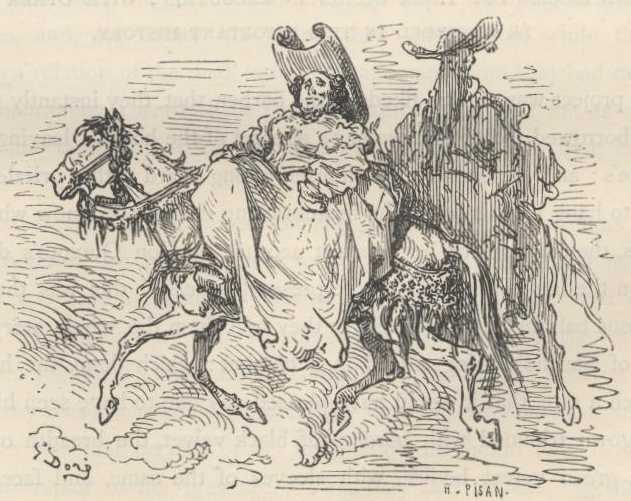
Just at this moment Sancho came up, and on seeing the pair in such a costume he was unable to restrain his laughter; the barber, however, agreed to do as the curate wished, and, altering their plan, the curate went on to instruct him how to play his part and what to say to Don Quixote to induce and compel him to come with them and give up his fancy for the place he had chosen for his idle penance. The barber told him he could manage it properly without any instruction, and as he did not care to dress himself up until they were near where Don Quixote was, he folded up the garments, and the curate adjusted his beard, and they set out under the guidance of Sancho Panza, who went along telling them of the encounter with the madman they met in the Sierra, saying nothing, however, about the finding of the valise and its contents; for with all his simplicity the lad was a trifle covetous.

The next day they reached the place where Sancho had laid the broom-branches as marks to direct him to where he had left his master, and recognising it he told them that here was the entrance, and that they would do well to dress themselves, if that was required to deliver his master; for they had already told him that going in this guise and dressing in this way were of the highest importance in order to rescue his master from the pernicious life he had adopted; and they charged him strictly not to tell his master who they were, or that he knew them, and should he ask, as ask he would, if he had given the letter to Dulcinea, to say that he had, and that, as she did not know how to read, she had given an answer by word of mouth, saying that she commanded him, on pain of her displeasure, to come and see her at once; and it was a very important matter for himself, because in this way and with what they meant to say to him they felt sure of bringing him back to a better mode of life and inducing him to take immediate steps to become an emperor or monarch, for there was no fear of his becoming an archbishop. /

--


Friday, May 9, 2025

26.5 神父欲裝扮做一个流浪姑娘

26.5 Sîn-hū boeh chng-pān chò chi̍t-ê liû-lōng ko͘-niû

Sancho thiaⁿ-liáu, án-ne hôe-tap:

"Sian-siⁿ, nā ūn-tô͘ án-ne kiâⁿ, goán chú-lâng bô chò hông-tè, sī chò tōa chú-kàu, góa siūⁿ boeh chai, sûn-iû tōa chú-kàu it-poaⁿ tek hō͘ sū-chiông siáⁿ thāi-gū?"

"It-poaⁿ tek," sîn-hū kóng, "in hō͘ in ki-pún ê tin-thiap a̍h chit-bū, a̍h chhin-chhiūⁿ kóng sèng-khì khàn-siú ê chit-ūi, che hō͘ in ū bē-bái ê kò͘-tēng siu-ji̍p, bô pau-koat chè-tôaⁿ hùi-iōng, he hoān-sè ke koh-khah chē."

"Tān-sī, nā án-ne," Sancho kóng, "sū-chiông tek-khak bē-sái ū hun-in, koh siōng-bô tio̍h chai án-chóaⁿ hia̍p-chō͘ chò mî-sat. Nā-sī án-ne, góa hāi ah, in-ūi góa í-keng chhōa ah, góa iū koh liân jī-bó͘ A, B, C to m̄-bat. Góa boeh án-chóaⁿ hó, ká-sú goán chú-lâng hèng boeh chò tōa chú-kàu, bô-ài chò hông-tè, chhin-chhiūⁿ kài chē iû-kiap khî-sū án-ne?"

"Bián hoân-ló lah, Sancho pêng-iú," thì-thâu-sai kóng, "goán ē kiû lín chú-lâng, kā i kiàn-gī, sīm-chì kō͘ liông-sim khǹg i tio̍h chò hông-tè, m̄-thang chò tōa chú-kàu, in-ūi án-ne tùi i khah sek-tòng, in-ūi i ê bú-châi khah hó kòe bûn-châi."

"Góa mā sī án-ne siūⁿ," Sancho kóng, "sui-bóng, góa kā lí kóng, i chò siáⁿ to sek-ha̍p. Taⁿ góa eng-kai chò ê, tō sī kî-tó Sîn kā i an-pâi kàu tùi i siōng hó ê só͘-chāi, kàu i ē-tàng tì-ìm góa siōng-chē ê só͘-chāi."

"Lí kóng kah kài ū-lí neh," sîn-hū kóng, "lí ē chiâⁿ-chò chi̍t-ê hó Kitok-tô͘. Tān, taⁿ pit-su ài chò ê sī, siūⁿ hoat-tō͘ khì khó͘-khǹg lín chú-lâng, mài koh chò lí só͘ kóng ê hit-chióng bô-hāu ê khó͘-siu. Lán siōng-hó sī seng oat ji̍p-khì chit-keng kheh-chàn, khì siūⁿ khòaⁿ boeh chhái-chhú siáⁿ kè-ōe, sūn-sòa chia̍h-pn̄g, in-ūi í-keng sī chia̍h-pn̄g ê sî-kan ah lah."

Sancho kóng in ē-sái ji̍p-khì, tān i boeh tī gōa-kháu tán, í-āu chiah kā in kóng i bô-ài ji̍p-khì, í-ki̍p bô sek-ha̍p ji̍p-khì ê in-toaⁿ. M̄-koh, i iang in chah kóa sio ê chia̍h-mi̍h hō͘ i, kap chah kóa tōa-be̍h hō͘ Rocinante. In ji̍p-khì, lâu i tī gōa-bīn, thì-thâu-sai koh chin kín chah mi̍h-kiāⁿ chhut-lâi hō͘ i chia̍h.

Kòe bô gōa kú, keng-kòe in siông-sè khó-lī boeh án-chóaⁿ si̍t-hiān bo̍k-piau, sîn-hū siūⁿ-tio̍h chi̍t-ê kài ha̍h Don Quixote ê kháu-bī, koh ē-tit ta̍t-kàu bo̍k-tek ê chú-ì. Sîn-hū kā thì-thâu-sai kái-soeh kóng, i siūⁿ ê hoat-tō͘ sī, i ka-tī chng-pān chò chi̍t-ê liû-lōng ko͘-niû, á thì-thâu-sai chīn-liōng chng-pān chò sū-chiông, jiân-āu khì chhōe Don Quixote. Ké-pān ê siū úi-khut ko͘-niû khì kiû Don Quixote pang-chō͘, tùi che, eng-ióng ê iû-kiap khî-sū tek-khak bē kī-choa̍t. Boeh kiû i pang-chō͘ ê tāi-chì sī, tòe ko͘-niû kàu bó͘ chi̍t-ê só͘-chāi, hiòng chi̍t-ê tùi yi choh-ok ê pi-phí khî-sū pò-siû. Tông-sî, yi mā chhiáⁿ Don Quixote, tī hiòng pi-phí khî-sū oân-sêng pò-siû chìn-chêng, bē-sái iau-kiû yi pak-lo̍h bīn-am, í-ki̍p thàm-thiaⁿ yi ê pōe-kéng.

I ū sìn-sim, Don Quixote it-tēng ē tah-èng chiah-ê tiâu-kiāⁿ, án-ne in tō ē-tàng chhōa i lī-khui hia, hō͘ i tńg chhù, jiân-āu hó-hó chín-toàn i he ī-siông ê siáu-kông, siat-hoat i-tī.

(2024-5-16)

--

26.5 神父欲裝扮做一个流浪姑娘

Sancho 聽了, án-ne 回答:

"先生, 若運途 án-ne 行, 阮主人無做皇帝, 是做大主教, 我想欲知, 巡遊大主教一般 tek hō͘ 侍從啥待遇?"

"一般 tek," 神父講, "in hō͘ in 基本 ê 津貼 a̍h 職務, a̍h 親像講聖器看守 ê 職位, che hō͘ in 有袂䆀 ê 固定收入, 無包括祭壇費用, he 凡勢 ke koh-khah 濟."

"但是, 若 án-ne," Sancho 講, "侍從的確 bē-sái 有婚姻, koh 上無 tio̍h 知按怎協助做 mî-sat. 若是 án-ne, 我害 ah, 因為我已經娶 ah, 我又 koh 連字母 A, B, C to m̄-bat. 我欲按怎好, 假使阮主人 hèng 欲做大主教, 無愛做皇帝, 親像 kài 濟遊俠騎士 án-ne?"

"免煩惱 lah, Sancho 朋友," 剃頭師講, "阮 ē 求恁主人, kā 伊建議, 甚至 kō͘ 良心勸伊 tio̍h 做皇帝, m̄-thang 做大主教, 因為 án-ne tùi 伊 khah 適當, 因為伊 ê 武才 khah 好過文才."

"我 mā 是 án-ne 想," Sancho 講, "雖罔, 我 kā 你講, 伊做啥 to 適合. 今我應該做 ê, tō 是祈禱神 kā 伊安排到 tùi 伊上好 ê 所在, 到伊 ē-tàng 致蔭我上濟 ê 所在."

"你講 kah kài 有理 neh," 神父講, "你 ē 成做一个好 Kitok 徒. 但, 今必須愛做 ê 是, 想法度去苦勸恁主人, 莫 koh 做你所講 ê 彼種無效 ê 苦修. 咱上好是先 oat 入去這間客棧, 去想看欲採取啥計畫, 順紲食飯, 因為已經是食飯 ê 時間 ah lah."

Sancho 講 in ē-sái 入去, 但伊欲 tī 外口等, 以後才 kā in 講伊無愛入去, 以及無適合入去 ê 因端. M̄-koh, 伊央 in 扎寡燒 ê chia̍h-mi̍h hō͘ 伊, kap 扎寡大麥 hō͘ Rocinante. In 入去, 留伊 tī 外面, 剃頭師 koh 真緊扎物件出來 hō͘ 伊食.

過無偌久, 經過 in 詳細考慮欲按怎實現目標, 神父想著一个 kài ha̍h Don Quixote ê 口味, koh ē-tit 達到目的 ê 主意. 神父 kā 剃頭師解說講, 伊想 ê 法度是, 伊 ka-tī 裝扮做一个流浪姑娘, á 剃頭師盡量裝扮做侍從, 然後去揣 Don Quixote. 假扮 ê 受委屈姑娘去求 Don Quixote 幫助, tùi che, 英勇 ê 遊俠騎士的確袂拒絕. 欲求伊幫助 ê 代誌是, 綴姑娘到某一个所在, 向一个 tùi 她作惡 ê 卑鄙騎士報仇. 同時, 她 mā 請 Don Quixote, tī 向卑鄙騎士完成報仇進前, 袂使要求她剝落面掩, 以及探聽她 ê 背景.

伊有信心, Don Quixote 一定 ē 答應 chiah-ê 條件, án-ne in tō ē-tàng 𤆬伊離開 hia, hō͘ 伊轉厝, 然後好好診斷伊 he 異常 ê 痟狂, 設法醫治.

(2024-5-16)

--

26.5

To which Sancho made answer, /

“If fortune, sirs, should bring things about in such a way that my master should have a mind, instead of being an emperor, to be an archbishop, I should like to know what archbishops-errant commonly give their squires?”

“They commonly give them,” said the curate, "some simple benefice or cure, or some place as sacristan which brings them a good fixed income, not counting the altar fees, which may be reckoned at as much more.”

“But for that,” said Sancho, “the squire must be unmarried, and must know, at any rate, how to help at mass, and if that be so, woe is me, for I am married already and I don’t know the first letter of the A B C. What will become of me if my master takes a fancy to be an archbishop and not an emperor, as is usual and customary with knights-errant?”

“Be not uneasy, friend Sancho,” said the barber, “for we will entreat your master, and advise him, even urging it upon him as a case of conscience, to become an emperor and not an archbishop, because it will be easier for him as he is more valiant than lettered.”

“So I have thought,” said Sancho; “though I can tell you he is fit for anything: what I mean to do for my part is to pray to our Lord to place him where it may be best for him, and where he may be able to bestow most favours upon me.”

“You speak like a man of sense,” said the curate, “and you will be acting like a good Christian; but what must now be done is to take steps to coax your master out of that useless penance you say he is performing; and we had best turn into this inn to consider what plan to adopt, and also to dine, for it is now time.”

Sancho said they might go in, but that he would wait there outside, and that he would tell them afterwards the reason why he was unwilling, and why it did not suit him to enter it; but he begged them to bring him out something to eat, and to let it be hot, and also to bring barley for Rocinante. They left him and went in, and presently the barber brought him out something to eat. /

By-and-by, after they had between them carefully thought over what they should do to carry out their object, the curate hit upon an idea very well adapted to humour Don Quixote, and effect their purpose; and his notion, which he explained to the barber, was that he himself should assume the disguise of a wandering damsel, while the other should try as best he could to pass for a squire, and that they should thus proceed to where Don Quixote was, and he, pretending to be an aggrieved and distressed damsel, should ask a favour of him, which as a valiant knight-errant he could not refuse to grant; and the favour he meant to ask him was that he should accompany her whither she would conduct him, in order to redress a wrong which a wicked knight had done her, while at the same time she should entreat him not to require her to remove her mask, nor ask her any question touching her circumstances until he had righted her with the wicked knight./

And he had no doubt that Don Quixote would comply with any request made in these terms, and that in this way they might remove him and take him to his own village, where they would endeavour to find out if his extraordinary madness admitted of any kind of remedy.

c26e.jpg (48K)

--


Don Quixote/ 唐.奇訶諦 目錄

Don Quixote /by Miguel de Cervantes /Eng Tran by John Ormsby https://www.gutenberg.org/cache/epub/996/pg996-images.html#ch74b Don Quixote/唐....